
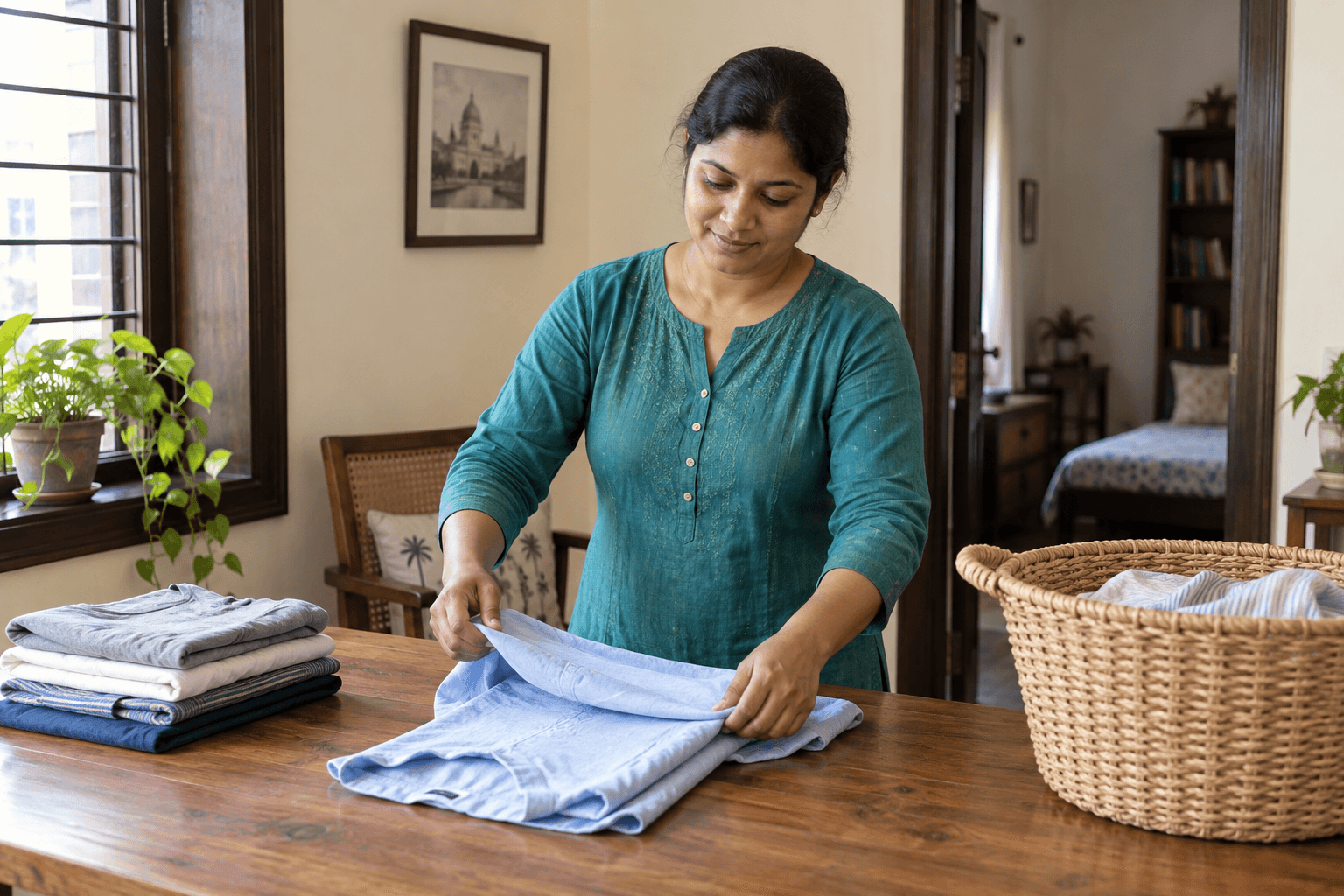
Fabric names help you describe a garment, but they do not provide a complete laundry instruction. Read the fibre composition, the construction description and the care label as different pieces of information. Before anyone washes or irons an item, the instructions for that finished item still need to be clear.
A household basket can contain a cotton kurta, a blended shirt, a knitted top and a lined occasion garment. Sorting those into a single category called “fabric” hides useful differences. This guide explains the vocabulary so that a family and its laundry helper can discuss the actual clothes without guessing a treatment from a familiar name.
Start with the fibre: what is the material made from?
Cotton, wool and polyester are fibre names. Linen is made from flax. A fibre name describes material used in a textile; it does not tell you everything about how the finished garment was made.
| Fibre group | Common names you may encounter | What the group describes |
|---|---|---|
| Natural plant fibres | Cotton; flax used for linen | Fibres obtained from plants |
| Natural animal fibres | Wool; silk | Protein-based fibres from animal sources |
| Manufactured cellulosic fibres | Rayon; lyocell | Manufactured fibres based on cellulose |
| Synthetic fibres | Polyester; nylon; spandex | Manufactured fibres based on synthetic polymers |
These broad distinctions follow Cotton Incorporated's educational classification. They are a reference to material families, not a washing or ironing chart. The categories do not rank garments by quality or establish a suitable laundry method. CottonWorks: Textile Fibers
For a household record, copy the composition actually printed on the garment. Do not replace a precise statement with a guess such as “probably cotton.” If the label is missing, record that the composition is unknown. That makes the gap visible to the owner instead of turning an impression into an instruction.
Woven and knitted describe construction
Weaving interlaces sets of yarns. Knitting forms fabric through interlocking loops of yarn. These are ways of constructing cloth, whereas a fibre name describes its material. The National Cotton Council's explanation shows both woven and knitted cotton manufacture. Cotton: Fabric Manufacturing
Consequently, “cotton” and “knitted” are not competing answers to the same question. A description can contain both. Likewise, knowing that something is woven does not identify its fibre composition. When speaking to a helper, use the description that is supported by the label or product information and leave the rest unspecified.
There is no need to become a textile examiner before arranging household help. The useful result is a more accurate question: “This label says cotton, but what are the care instructions for this particular shirt?” That is more actionable than asking the helper to apply one method to everything that appears similar.
Read blends without inventing a care formula
A composition label may list more than one fibre with percentages. In a fictional example, a shirt might state 60% cotton and 40% polyester. Record both entries rather than calling it simply cotton. Those numbers describe the stated composition; they are not proportions for detergent, water or a mixed temperature setting.
Do not calculate a compromise care method from the percentages. This guide does not provide such a formula. Read the garment's care directions separately and resolve an unclear instruction before including the item in an agreed work batch.
Also distinguish the part being described. If a garment has separate labels or descriptions for its outer material and lining, keep those descriptions attached to the correct parts. Do not silently treat the outer material's name as a complete description of everything attached to it.
Use this label-reading decision table
| Information found | Question it helps answer | Question it does not settle | Practical next step |
|---|---|---|---|
| Fibre composition | What materials does the label identify? | Which laundry process is permitted? | Read the care directions on the same item |
| Woven or knitted description | How is the fabric constructed? | What are its exact fibres? | Keep composition and construction separate |
| Two percentage entries | Is the stated material a blend? | What “average” care setting should be used? | Copy the whole composition; do not calculate settings |
| Separate outer and lining details | Which information describes which part? | Whether one method suits the complete item | Check finished-garment instructions |
| A familiar shop or household name | How does the owner recognise the item? | Whether its composition is verified | Use it as an identifier, not a treatment instruction |
| Missing or unreadable label | What information is absent? | Whether guessing is safe for that garment | Ask the owner to obtain usable guidance |
This table is an interpretation aid. Use the existing laundry care-label register when you need a reusable record of the actual instructions and unresolved questions for individual garments.
Work through three garments: a fictional example
Maya is preparing a small household batch in Kolkata. She first writes three descriptions: a blue office shirt, a cream kurta and an occasion jacket. She wants her helper to recognise each item, so she does not rely on colour alone where two items look alike.
The office shirt has a readable blended composition and readable care instructions. Maya records both without rewriting the blend as a single fibre. The kurta is described as cotton in its product information, but its care label is no longer legible. She records the material information she has and leaves the laundry instruction unresolved.
The jacket has separate information for the outer fabric and lining. Maya keeps the entries distinct and checks the instructions for the whole jacket. She does not put it into the agreed batch merely because one part has a familiar fibre name.
The outcome is not a newly invented wash programme. It is a clear batch decision: the shirt can be considered under its confirmed instructions; the other questions remain visible until Maya has suitable answers. The helper receives a shorter, more reliable brief instead of being expected to identify fabrics by touch.
Make household preferences specific
Preferences such as where an item is returned, whether it belongs in a separate person's group and who answers an unresolved question are useful operational details. Keep them separate from the garment's care instructions. A preference for quick completion does not supply missing manufacturer guidance.
Use the laundry preferences checklist to explain household routines. If ironing is also requested, pass on the relevant garment instructions rather than assuming that laundry approval covers every finishing step. Ironing help in Kolkata is a separate scope to discuss.
Avoid asking someone to identify an unknown fibre by an improvised destructive test. A household service enquiry can simply state what is known, what remains unclear and which items are excluded until clarified. Accurate uncertainty is more useful than a confident description that the label does not support.
Arrange help around the information you have
For laundry help in Kolkata, describe the tasks, available equipment, garment instructions and items requiring a separate decision. Availability, included work and the quotation must be confirmed for the enquiry; this guide does not promise specialist textile treatment, dry-cleaning collection or a guaranteed completion rate.
Contact Anjali Aaya and Nurse Care by phone or WhatsApp. The practical next step is a clear household brief, with missing garment information resolved before the affected work is agreed.