
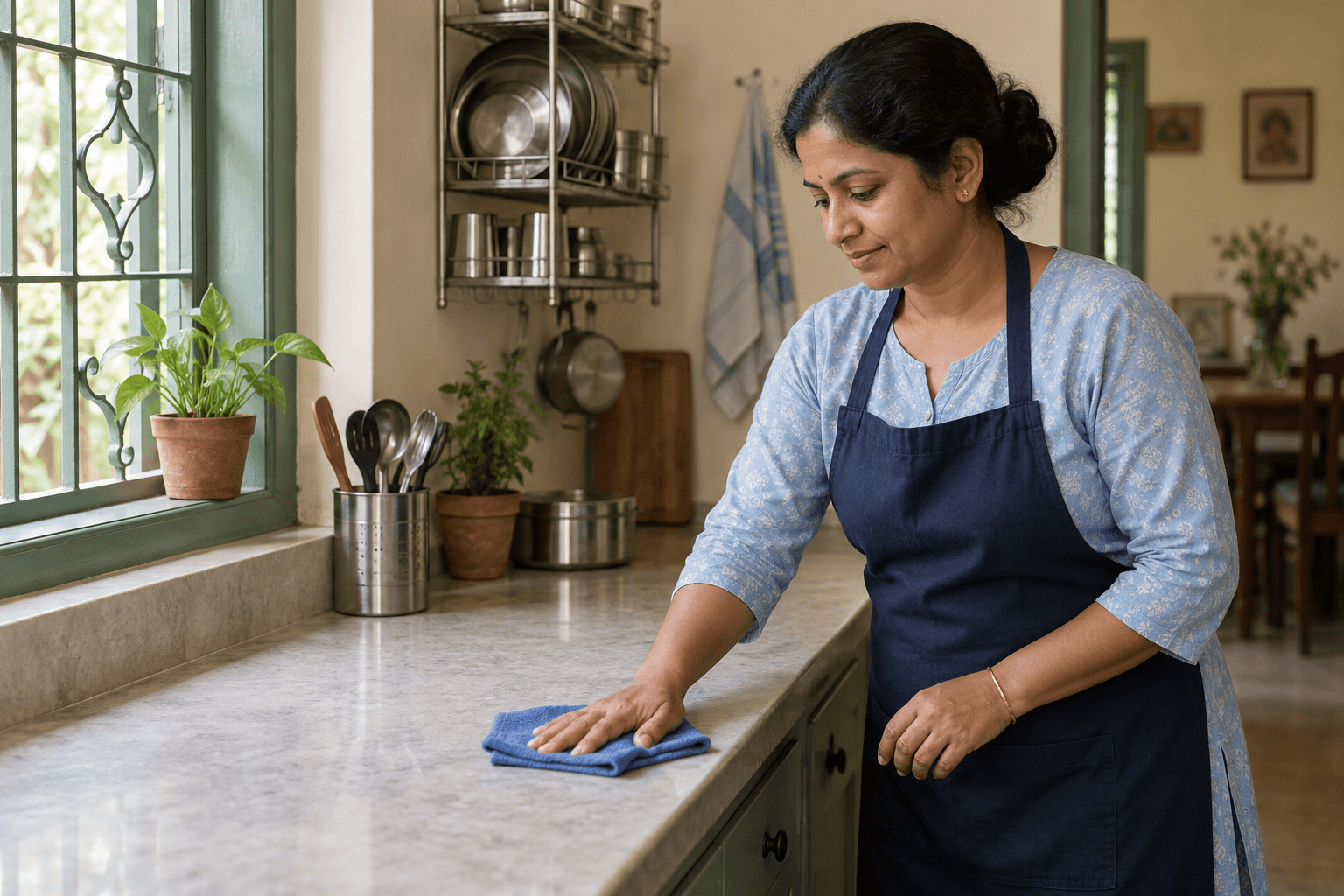
Clean an identified marble floor by removing loose grit, choosing a routine cleaner approved for that stone and following its application, rinsing and drying directions. Keep acidic cleaners away. A dull patch that remains after routine care may need assessment of the finish, not stronger cleaning. Begin by confirming that the floor is natural marble rather than a marble-patterned tile or another manufactured surface.
The aim of ordinary household care is to remove everyday soil while respecting the existing surface. Cleaning, polishing and repairing a finish are different jobs, even when a household uses “make it shine” to describe all three.
Identify the stone and the expected result
Find an invoice, stone supplier's note or installer handover. Ask which rooms have the same material and which only have a similar colour. A kitchen threshold can separate natural stone from ceramic tile; carrying one bucket through both rooms without checking the surfaces hides that important difference.
Ask the owner what the floor normally looks like when clean. A deliberately matte surface should not be judged against a glossy showroom photograph. In an older Kolkata home, photographs from an earlier family occasion may help locate a long-standing patch. They can document appearance, but they cannot identify its cause.
The Natural Stone Institute explains that marble belongs to an acid-sensitive group of stones. Its care guidance recommends gentle routine cleaning, avoiding acidic and abrasive products, and removing grit with suitable clean equipment. It also distinguishes acid etching from staining: acid can change the surface even without leaving a coloured stain. Persistent finish damage may need a stone professional's assessment. Natural Stone Institute care guidance.
Keep these distinctions in the task description. “Clean the accessible living-room marble” is actionable. “Remove every mark and restore the original shine” adds an outcome that routine household cleaning cannot promise.
Choose a routine product by instructions, not colour
Read the label for the intended material and task. A product used successfully on bathroom ceramic tiles is not automatically appropriate for marble. Check the cleaner's exact name, whether it is concentrated or ready to use, and whether its instructions address everyday maintenance or a different treatment.
FILA's CLEANER PRO instructions illustrate why this matters: they distinguish regular maintenance from after-installation cleaning, with different directions and conditional rinsing requirements. This is a product-specific example, not a dilution recipe for other bottles. Use the current instructions for the chosen product and the stone supplier's requirements together. FILA CLEANER PRO directions.
Make a short supply note the family can see: product name, intended marble room, photographed label if useful, and where that product is stored. Keep any specialist stone treatment in a separate line and do not use it during routine cleaning without its own instructions and permission. A similar bottle shape should not make those products interchangeable.
Work through one accessible area at a time
Before cleaning, note loose items, existing patches and any area that cannot be reached without moving heavy furniture. Move ordinary small belongings to a defined place so they can be returned to the right room. A basket of children's toys should not migrate permanently into a bedroom just because the living-room floor needs attention.
Prepare the permitted tools and product using their instructions. Remove loose debris, then complete the routine cleaning stages across a manageable area. The Natural Stone Institute advises following product directions, changing dirty cleaning water and thoroughly rinsing and drying after its described soap-cleaning method. Avoid treating that as a universal instruction to add soap or as a reason to override a particular product's care directions. Natural Stone Institute cleaning recommendations.
Arrange the work around the room's real use. If the dining table will be needed shortly, agree when that area can be returned rather than beginning the entire open-plan floor at once. Keep a clear route available while work is in progress, and check that the completed section is ready before returning objects.
Once the ordinary routine is finished, inspect the surface in the same lighting used before cleaning. A moving reflection from a window can make a patch appear to change as you walk around. Describe the position and appearance consistently rather than making a diagnosis from a single glance.
Record marks without turning them into an experiment
| Observation after routine care | Useful record | Next decision |
|---|---|---|
| Loose dirt has gone and the normal finish is visible | Area and routine completed | Return the room to use |
| A coloured patch remains in the same position | Size, location and any known spill history | Ask the supplier about the appropriate assessment |
| A pale or dull area remains without loose soil | Appearance before and after the visit | Do not promise that more mopping will restore gloss |
| A border or inset is a different material | Exact boundary in the room | Obtain its separate care instructions |
| Owner requests sealing or polishing | Requested outcome and product information, if known | Treat it as a separate specialist enquiry |
This table organises observations; it does not diagnose the stone. Avoid repeatedly trying products on a persistent patch. For broader questions about cleaning scope, the routine versus deep-cleaning comparison helps explain why a different task needs a separate discussion.
Fictional example: a living-room patch near the tea table
In a fictional Joka household, the family wants the marble living room ready for visitors. There is ordinary entrance dirt and a dull oval beside the tea table. The owner confirms that the oval predates the current visit and provides the stone supplier's care note.
The helper records the patch before work, prepares the agreed routine supplies and starts with the accessible entrance and seating area. A book basket and small stools have named temporary places. The heavy display cabinet remains in position, with the inaccessible strip recorded on the task list.
After cleaning, the entrance looks clear but the oval remains. The helper reports that difference and the owner sends its photograph to the stone supplier. No one describes the remaining patch as proof that the helper used too little product. The family gets a usable room and a precise follow-up question, while the next visit can focus on ordinary maintenance.
On the handover note, list each room with confirmed marble, the area completed, and any area that remained inaccessible or needs an owner decision. For adjacent tiled rooms, follow the separate tile-floor routine.
To discuss household cleaning help, call +91 98041 26771 or send a WhatsApp enquiry with the rooms, material and agreed routine. Confirm availability, tasks and charges directly. Specialist stain treatment, polishing and stone restoration need separate confirmation and are not implied by an ordinary cleaning enquiry.