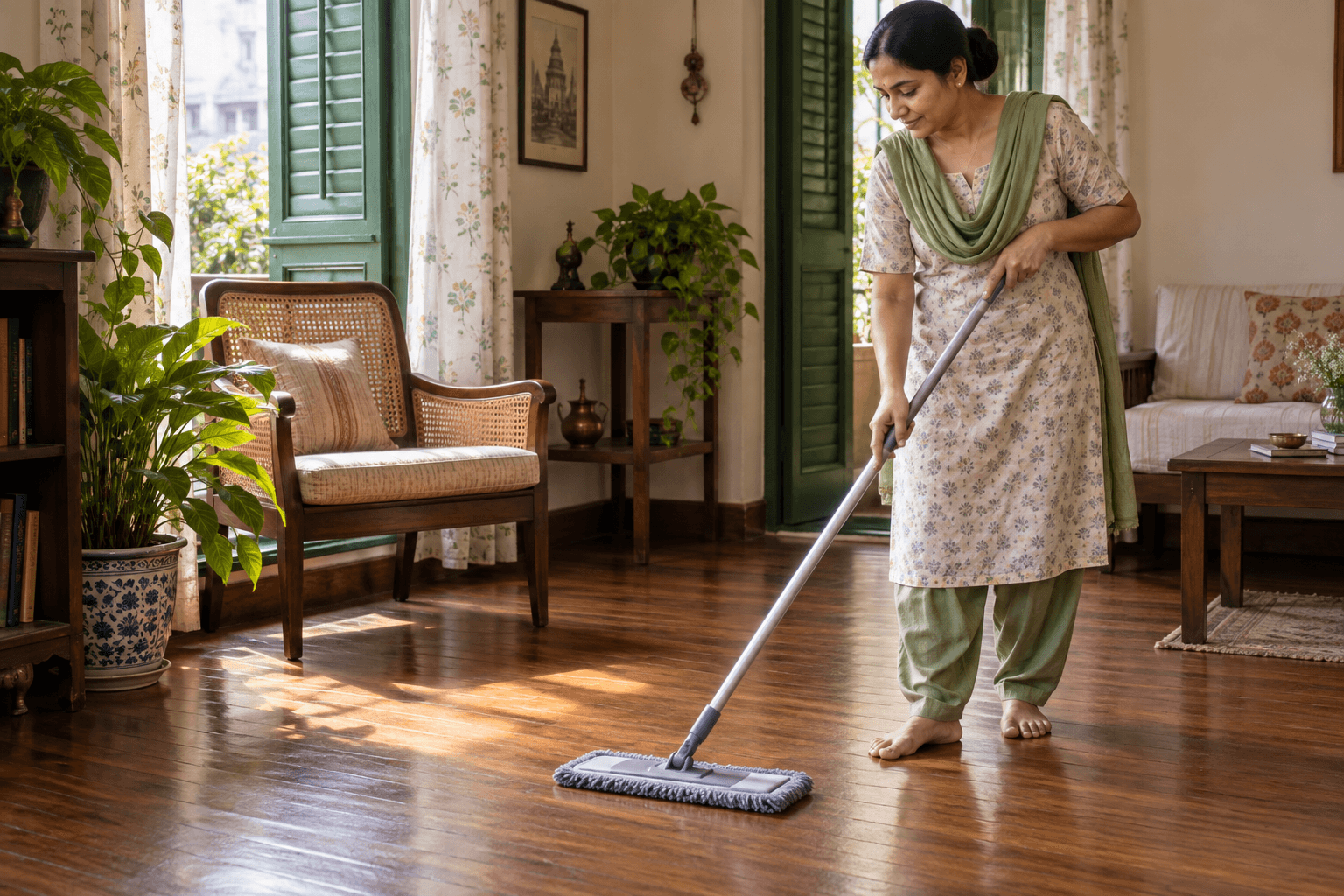
To clean a wooden floor, first identify the flooring and its finish, remove loose dirt with suitable equipment, then use the floor maker's permitted routine cleaner only where needed. The amount of moisture matters. A wood-patterned floor is not enough information to choose a method: real timber, laminate and vinyl can look similar but have different care instructions.
This guide helps a household or home helper organise ordinary care of an intact, identified indoor wood floor. Its useful endpoint is a clean, usable surface with unresolved marks described clearly, rather than an attempt to change the floor's colour or sheen.
Find the information that changes the method
Ask for the flooring invoice, product name, installer handover or saved care sheet. In a rented Kolkata flat, the landlord may have the only record. A photograph of the room helps the owner recognise which floor you mean, but cannot reliably identify its coating. Ask specifically whether the finish is lacquered, oiled or another system and whether it has been renewed since installation.
Keep the answers together: room, product, finish, permitted cleaner and routine equipment. “Brown bedroom floor” is a location description, not a care specification. If records are missing, ask the supplier before choosing wet care or a maintenance product. Continue other agreed household tasks while that question is resolved.
The distinction is practical. Bona's timber-care guidance gives different cleaner choices for ordinary finished timber and oiled flooring. It also advises minimal liquid, warns against steam cleaning and discourages vinegar, methylated-spirit mixtures and general-purpose cleaners on timber finishes. These are reasons to match the cleaner to the actual finish, rather than choose by fragrance or the word “floor” on a bottle. Bona's timber-floor maintenance guidance.
Separate a daily pass from periodic maintenance
Make a quick room assessment before collecting supplies. Is there loose grit near the doorway, ordinary food residue beside a chair, a fresh spill, or an old mark that the owner already knows about? Note any lifted edge or visibly damaged area before starting. Do not make a damaged patch the place where you test a new method.
Kährs recommends regular dry cleaning, with a well-wrung damp mop when necessary and prompt attention to spills. That supports a light routine rather than automatically washing the whole room every time. Use the relevant Kährs or other floor maker's instructions for the actual installed product. Kährs wood-floor maintenance guidance.
An owner may also have a bottle labelled oil, polish, refresher or maintenance treatment. Keep that separate from the routine cleaner. Its presence in the cupboard is not an instruction to apply it during a normal cleaning visit. Record the product name for the owner if they want to arrange a separate maintenance decision.
Set up a wood-floor routine that another person can repeat
Choose the agreed equipment and check that the working surface is clean. A pad stored with gritty balcony-cleaning tools needs attention before it enters the bedroom. Set out only the product identified in the care note, retaining its original label so preparation and application instructions remain available.
Remove small loose items to a defined temporary place. Leave heavy furniture where it is unless its movement has been planned with suitable help. Identify an exit before starting any permitted damp work. In a room with one doorway, finish near that doorway rather than trapping yourself behind the last section.
Complete the manufacturer's routine sequence in manageable sections. Start with the loose dirt, then attend to the areas needing permitted further cleaning. Inspect the first completed section before extending the method across the room. This provides an early opportunity to notice a changed appearance or an unexpected result and refer back to the instructions.
Do not judge completion from fragrance. Look at the surface from the doorway and the normal seating position. Check whether visible debris remains around the furniture that was accessible. Compare any pre-existing mark with your original observation rather than repeatedly treating it until it looks different.
Make the right decision for each observation
| What you find | Useful decision | What to tell the household |
|---|---|---|
| Product identified, finish recorded and care instructions available | Follow that routine with its named supplies | Which rooms were completed |
| Timber confirmed but coating unknown | Obtain finish information before choosing further treatment | The precise missing detail |
| A different floor continues beyond the bedroom doorway | Treat the threshold as a change of method | Where one routine ends and the other begins |
| An old mark remains after ordinary care | Record its position and the result without escalating | Whether it was present before cleaning |
| An accessible strip was cleaned but a wardrobe blocked the remainder | Leave an honest access note | Which area still needs a separate furniture-moving plan |
For the adjacent ceramic or porcelain surface, use the separate tile-floor cleaning guide. If a finished surface has a general residue problem, the guide to floors that still look dirty after mopping helps frame observations without assuming every mark is dirt.
Fictional example: two bedrooms with different care needs
In a fictional Behala home, one bedroom has recently installed engineered timber and the second has an older wood-effect floor. The family initially asks for both to be cleaned “the same as usual.” The helper asks for the saved handover information and discovers that only the first room's product is confirmed.
They label the work list by room, put the first room's care sheet beside its supplies and complete the agreed routine there. The older room waits for its product information; meanwhile, the helper continues with other scheduled chores. A dark mark beside the first room's bedside table remains, and the family confirms it was already present. The completion note records that mark and the area behind an unmoved chest, instead of calling the whole room restored.
The next visit is easier because the information is saved, not because the helper has memorised a universal recipe. A short product entry in the cleaning-supply inventory and a room-specific line in the chore planner preserve that decision.
For a home-help enquiry, describe the floor material, rooms, existing instructions and accessible tasks when contacting Anjali's home-cleaning service. Confirm the work and quote by call +91 98041 26771 or WhatsApp Anjali. Routine household help does not establish that refinishing or specialist wood-floor restoration is available.