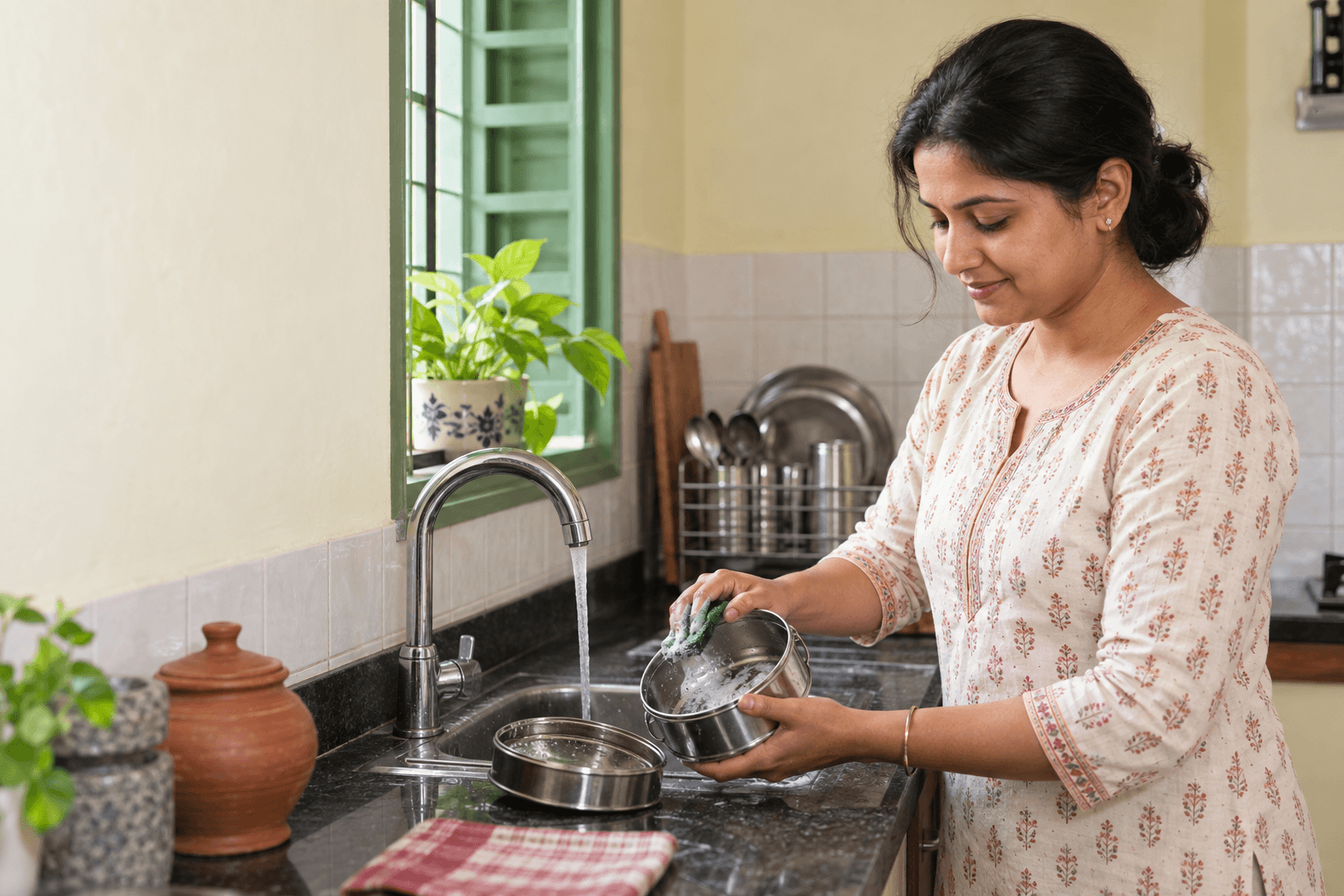
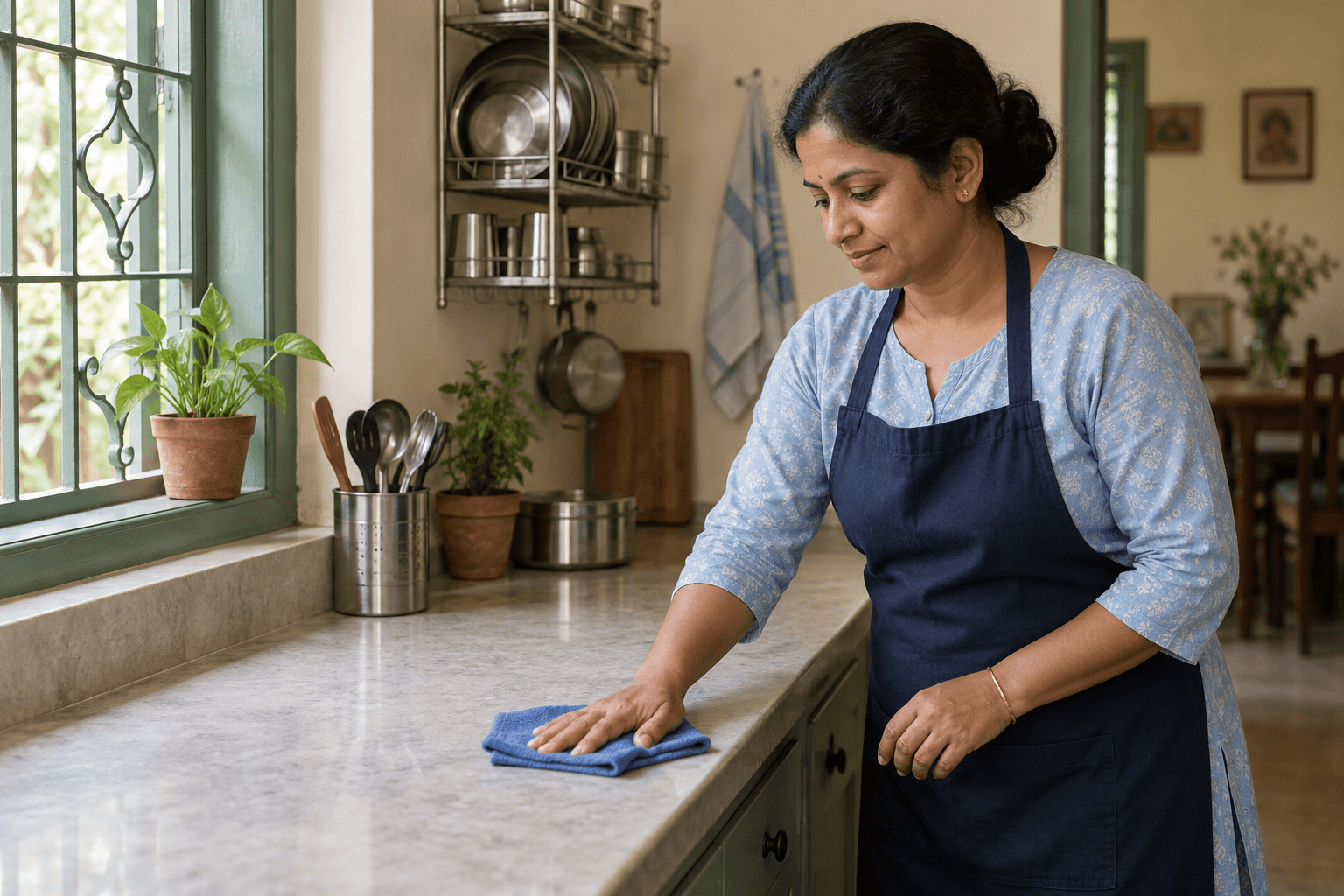
Give kitchen cloths clear jobs, keep ready-to-use cloths separate from used ones, and complete the washing and drying step before putting reusable cloths back into circulation. A surface-wiping cloth, a washing-up cloth and a towel used for drying clean dishes should not drift between jobs simply because they are nearby.
The Food Standards Agency's household guidance advises separate cloths for surfaces and washing up, regular washing or replacement, and washing and drying before reuse. This article turns those narrow principles into an everyday kitchen routine; it does not claim that a colour code sterilises anything. FSA household cleaning guidance
Decide what each cloth is for
Start with the tasks that actually happen in the kitchen. Distinguish wiping an appropriate surface, washing ordinary dishes and drying already-clean items. Keep hand-drying arrangements separate too. Do not call every textile beside the sink a kitchen towel and leave the next person to infer its purpose.
A small household can use plain labels or a colour system, but the meaning must be explained. There is no universal household rule that a particular colour belongs to one task. If the family uses blue for surfaces, that choice is an identification aid for that home.
Avoid using a cloth assigned to another room just because the kitchen supply has run out. A shortage should trigger replenishment or laundering, not an unannounced change of purpose.
Create a one-way route through the kitchen
A simple route has three states: ready for its assigned task, used and awaiting washing, then washed and drying. Return a cloth to the ready supply only when its required care is complete.
The locations can be modest. A clearly identified place for ready cloths and a separate appropriate place for used items may be enough. The important feature is that someone arriving later can distinguish them. A damp cloth left over the sink edge does not reliably communicate whether it is ready, used or being dried.
Choose the drying arrangement according to the cloth's instructions and the household setup. Do not hide a still-damp cloth among the ready supply to make the area look tidy. The FSA specifically includes drying before reuse in its advice. FSA guidance on cloths and towels
Keep this route visible to whoever cooks, washes dishes and does laundry. A routine fails if one person separates used cloths while another returns them to the clean drawer because they assume the separation was accidental.
Follow the actual cloth's care directions
Reusable cloths are not all interchangeable. Keep the care label or the manufacturer's instructions available for the product you have, including permitted washing, drying and any exclusions.
For example, Vileda's Canadian Microfibre All-Purpose Cloth page permits machine or handwashing in warm water and excludes fabric softener and bleach. That is a product-specific example of why a generic “wash all cloths the same way” instruction can conflict with the item guidance. It is not a recommendation to buy that product or to copy its care method onto every cloth. Vileda product use and care
Do not improvise a boiling, microwave or chemical-disinfection method because a social-media tip describes it as a quick fix. This guide does not establish that such a method is appropriate for the textile, any attached parts or the equipment. Where the required care is unclear, clarify it before putting the item back into use.
Use a task-and-state table
| Situation | Practical action | What the arrangement needs |
|---|---|---|
| Starting surface wiping | Take the ready cloth assigned to that task | Recognisable task designation |
| Beginning washing up | Use the separate washing-up cloth or suitable tool | A supply that is not borrowed from surface wiping |
| Finishing with a used cloth | Move it into the agreed washing route | A place visibly distinct from ready cloths |
| A washed cloth is still drying | Keep it in the drying stage | A location that will not be mistaken for ready storage |
| Care instructions are unknown | Resolve the instructions before reuse | Product identity or retained care information |
| No suitable ready cloth remains | Replenish the appropriate supply or revise the task | Someone able to manage that shortage |
This table teaches the flow of items through a task. Use the cleaning supply inventory for stock quantities and product details instead of creating another parallel inventory.
A fictional shared-kitchen example
Rupa cooks breakfast while another family member washes dishes later. The home has several similar cloths. Both people have been using whichever one is closest, and neither can tell which has just been used on a surface.
They choose ordinary task names and separate the ready groups. They also agree a distinct place for cloths awaiting washing and a drying location that is not the ready drawer. They explain the arrangement to the household helper without relying on colour alone.
On the first day, the washing-up supply runs out. The helper reports that shortage rather than borrowing the surface cloth. The household adjusts how many suitable cloths are available between washing sessions.
During the next review, they discover that the drying location is being cleared too early. They change the location so that a cloth's state is easier to recognise. The improvement is a workable shared routine, not a claim that the kitchen has become germ-free.
Check the routine at the point it breaks
If cloths repeatedly arrive in the wrong group, ask which step is unclear. A label may be hidden, the used-item location may be inconvenient, or the person doing laundry may not know which group receives a finished item.
Change one practical feature and observe whether the confusion stops. Do not assume the problem is solved merely because new coloured cloths have been purchased. The route from use to washing, drying and return still has to work.
For reusable items included in a laundry-help arrangement, explain the actual textile-care instructions and how finished items return to their assigned kitchen groups. For dishwashing help, make the appropriate tools available at the start of the agreed task.
Ask for help with a defined routine
A cloth routine can be part of a broader kitchen-cleaning scope, but it does not automatically add specialist sanitisation or every laundering task to a visit. Confirm the included work, supplies and responsibilities.
Contact Anjali Aaya and Nurse Care by phone or WhatsApp to discuss household help in Kolkata. Share the tasks and preferred timing, then confirm availability and the relevant quotation.