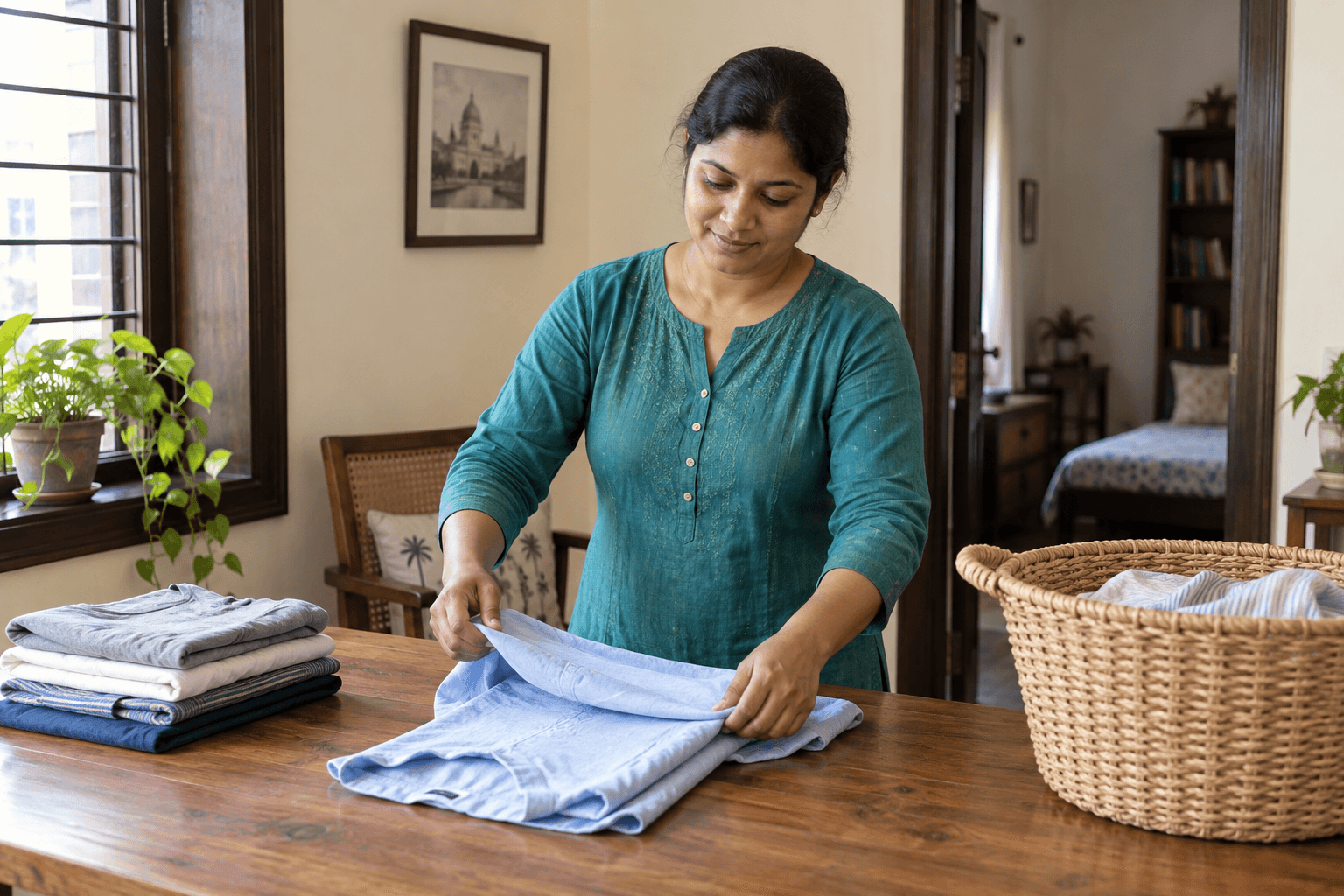
In-home laundry help and professional textile cleaning answer different needs. A household helper may assist with agreed washing, drying, folding or ironing tasks using the household's accepted instructions and equipment. A professional textile cleaner assesses items for the processes it provides. Before comparing prices, establish which kind of work the garments need and which provider has actually accepted it.
A search for laundry and dry cleaning can return businesses with very different arrangements. Some collect and process garments elsewhere; others supply help inside the home. A collection option, specialist treatment or pressing service should not be assumed simply because a page uses the word laundry.
Let the garment instructions inform the first decision
The practical method distinction is that domestic washing uses water, while professional dry cleaning uses cleaning solvents selected for the accepted process. Dry cleaning does not mean simply drying clothes after a wash. Professional wet cleaning is another water-based process, with equipment and finishing requirements that differ from a household machine. GINETEX separates these care categories and explains that the letters for professional dry cleaning communicate solvent information to professional cleaners. The garment's complete care instructions remain the starting point; this distinction alone does not select a suitable treatment. See the GINETEX care-symbol guidance for the original explanations.
Keep the complete garment instructions available when asking about an item. Do not copy only the part that seems convenient for the proposed booking. If the label is unclear, missing or inconsistent with other supplied instructions, identify that question before the item joins an ordinary household load. A helper should not have to guess a treatment because the family has already booked a visit.
This guide is about choosing and describing help. It does not identify a safe treatment for a particular fabric, set washing or ironing temperatures, or approve a stain-removal method. For an item requiring assessment, ask the garment maker or an appropriate textile-care professional and retain the relevant response.
Separate the process from the work location
Two enquiries may both use the word washing while expecting different work. One family may want help operating its own machine under agreed instructions. Another may want garments collected, processed elsewhere and returned. The difference affects custody, equipment, responsibility and what counts as completion.
Use the following matrix to make the expected arrangement explicit. It describes questions to ask, not a promise that every listed service is available from Anjali.
| Requirement | Where work is expected | What must be clarified | Evidence of completion to agree |
|---|---|---|---|
| Household washing help | At the home using accepted equipment | Included items, instructions, machine use and household responsibilities | Which accepted tasks were completed and what remains |
| Drying and folding assistance | At the agreed household location | Available drying space, garment directions and later handover | Current status of each accepted group |
| Ironing assistance | At the agreed working station | Suitability, finish preferences, equipment and accepted quantity | Count and return location of completed items |
| Off-site laundry processing | At a separately identified provider | Collection, custody, accepted process, return and charges | Itemised receipt and agreed return details |
| Professional dry cleaning | At a provider that accepts the required work | Garment assessment, permitted professional process and limitations | Provider's item record and agreed outcome |
| Professional wet cleaning | At a provider offering that specific process | Whether the garment instructions and professional assessment permit it | Accepted process and item-level return record |
Do not treat collection as proof that a treatment has been accepted. The receiving provider may need to assess an item before confirming the work. Likewise, a confirmed home-help visit does not establish that every garment in the household can be washed or pressed during it.
Build separate item groups before asking for quotes
Start with the garments for which instructions and ownership are clear. Keep items awaiting an answer in a separate, identified group. This can prevent an unanswered question about one piece from being overlooked within a larger routine load.
For each proposed group, note the item count, the work requested and any instructions that the provider needs to see. A short description is enough for an initial conversation. If photographs are later useful, show the relevant label or concern without circulating unrelated household details.
The laundry care-label register can keep the item-specific instructions together. It records what the household supplies; it does not replace the garment maker's directions or provide a professional assessment. If you use the form, leave an uncertain entry visibly pending rather than filling it with a familiar setting from another garment.
Compare quotes for the same accepted work
A per-visit household-help quote and an item-based processing quote describe different service units. A lower number alone does not tell you which arrangement covers the need. Keep the provider's original unit and ask what is included before attempting a comparison.
Check who supplies equipment or products, whether any travel or collection charge applies, and what happens if a proposed item is not accepted. Ask separately about ironing if that is wanted. Drying, folding and pressing are not automatically unlimited additions to a washing request.
Confirm when an amount becomes payable and which changes need another quote. Monthly payment or payment every fourteen days describes a payment arrangement; it does not make every item part of one unlimited service. Use the actual written terms for the provider you are considering instead of assuming that different businesses use the same conditions.
Avoid assigning a specialist textile-care cost from Anjali's eligible aya/home-help starting rate. Laundry-only work and any extra duties need an individually confirmed scope and quotation. An advertised hourly starting point is not evidence of a dry-cleaning tariff or a whole-wardrobe package.
Agree custody and the return check
If items leave the home through a separately arranged provider, confirm who receives them and how the item count is recorded. Identify which person can authorise changes after assessment. Keep the collection record connected to the return record so that a later question concerns a named item rather than an unidentified bag.
For work that stays inside the home, agree where accepted items wait and where completed items go. Record the state at handover: waiting for instructions, being worked on, ready for the next task or returned. A visit ending is not proof that garments are dry or that every requested finishing task is complete.
Use the garment condition and concerns record when a particular observation needs to be shared. Describe what was seen and when it was recorded. An observation alone does not establish who caused a problem or determine liability; resolve those questions with the relevant provider and evidence.
Fictional example: one family, two different requirements
A fictional Kolkata family has an ordinary household laundry group and several occasion garments whose instructions need separate attention. The family initially asks for a single laundry quote without explaining the difference.
After reviewing the request, the coordinator makes two lists. The household-help enquiry describes only the accepted in-home tasks, equipment, visit pattern and available drying arrangement. The second list remains pending while the owner asks an appropriate professional cleaner about the occasion garments. No treatment or collection is presumed from the first enquiry.
The household group also includes items that will need someone to check them after the helper's visit. The family names that person and reviews the actual drying-space plan before starting more washing. For the separate professional enquiry, the owner requests an itemised response before agreeing to hand over anything.
This fictional case illustrates how to separate requirements. It is not an Anjali customer story, a referral to a particular cleaner or confirmation that the business offers off-site textile processing.
Ask Anjali about the confirmed in-home scope
For laundry help in Kolkata, describe the items, accepted tasks, equipment, days and locality. If you also need ironing help, explain that separately so the workload and suitability can be discussed. Collection, off-site processing and dry cleaning are not confirmed standard Anjali inclusions.
Call +91 98041 26771 or enquire on WhatsApp. The main office is at No. 1, MG Road, Kalitala, Near State Bank of India, Joka, Kolkata - 700104. For another city in India, ask for a local availability check. Confirm the full scope, responsible contact, timing and complete price before relying on a booking.