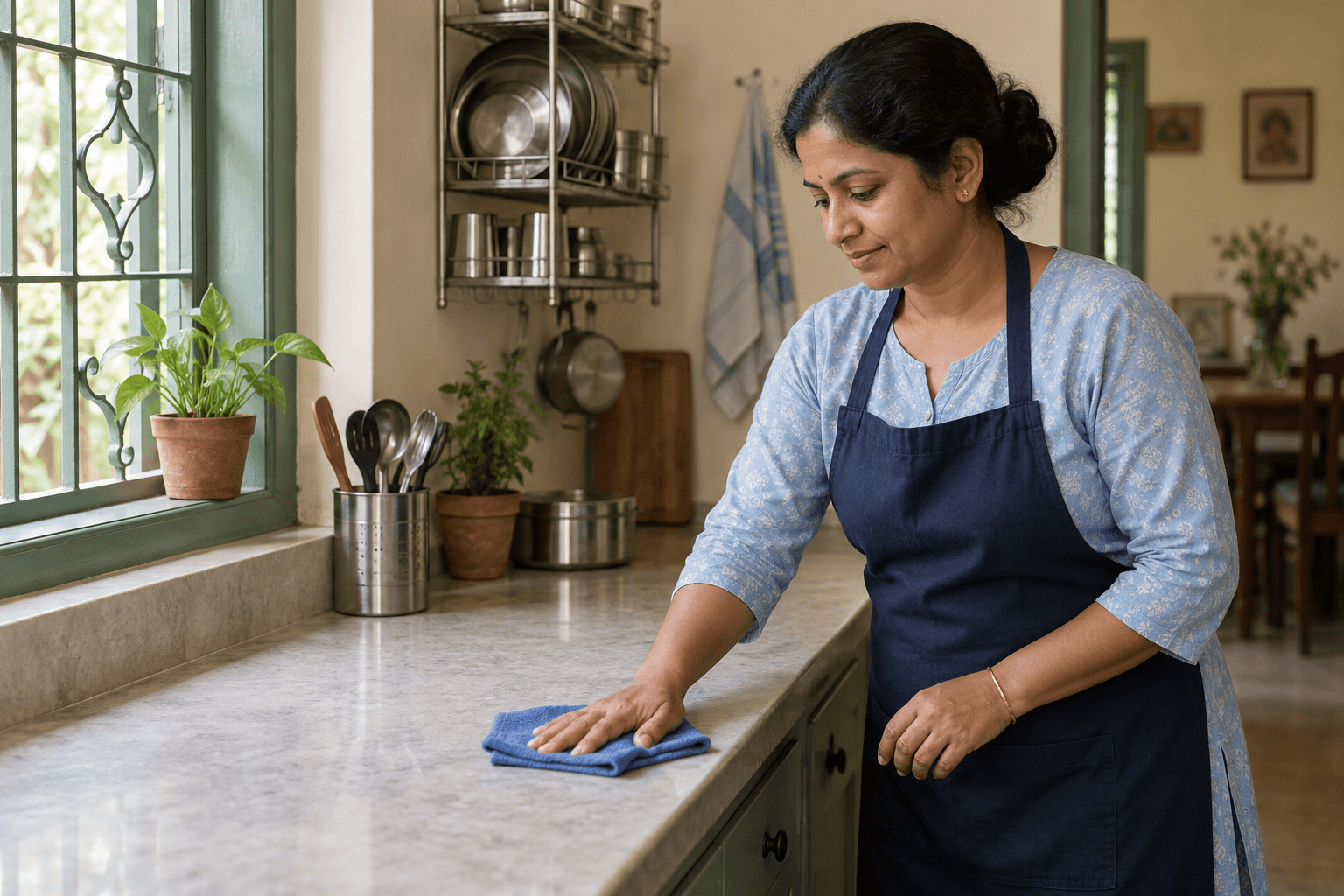

Organising a small kitchen begins with the route people take to prepare food, cook, wash utensils and put them away. Identify the items used every day, decide their homes with the household and test the arrangement before buying storage products. A compact space does not need every object visible; it needs enough clear work area and a return system people will actually follow.
Map the day before emptying a cupboard
Watch one ordinary meal preparation or ask the cook to describe it. Where do washed vegetables wait? Which vessel is used most often? Where are clean plates collected, and where do wet utensils dry? In a small Kolkata flat, the same counter may serve several of these purposes during the day. The organising plan should make that sequence easier, rather than simply fitting more boxes into a cabinet.
Sketch the kitchen as a few working areas: food preparation, heat and cooking, washing, drying and return storage. The areas may overlap physically. The key is to give each important item a location near the task where it is used, as far as the actual kitchen permits. IKEA India's cabinet guide also frames kitchen storage around activity areas. Its examples are product suggestions, not requirements for this household.
Ask the person who cooks and the person who washes dishes to explain any friction. A pan stored high above the stove may be easy to put away but awkward to lift down daily. A cup rack next to a sink may be convenient for washing but block a small preparation area. The arrangement must be judged by use, not appearance alone.
Sort by frequency and ownership
Make three temporary groups: used every day, used sometimes, and needs an owner decision. Keep the third group visible to its owner rather than quietly discarding it. A family may have vessels reserved for guests, religious use or a particular person; the worker cannot decide their value from frequency alone. The keep-move-discard board helps document those choices without treating “not used last month” as automatic permission to throw something away.
Return daily items to reachable places. Put occasional objects in less convenient but still safe storage, checking that their weight and the shelf's intended use are suitable. A shelf is not useful if a person must move six containers to reach one tin every morning. IKEA India's pantry article similarly discusses visibility and convenient access for commonly used items. It does not establish that every home should buy transparent containers or transfer food out of its packaging.
Protect food information during a storage change
If food is decanted, keep whatever identification, date and instructions the household needs. Do not pour unlabelled ingredients into identical jars because the row looks neater. Ask the owner how allergies, expiry information and special diets are handled. This guide is an organisation method, not a food-safety certification or substitute for the relevant food and package instructions.
Keep cleaning chemicals in their original labelled containers and in a place agreed by the household, away from food and children as the product label requires. Do not reuse food jars for cleaners. If a proposed storage spot near a hob, sink or electrical outlet seems unsuitable, check the appliance and product instructions before moving items there.
Trial a layout before purchasing organisers
Measure the usable inside width, depth and height of a shelf or drawer, including hinges and pipes. Many “space-saving” products consume room if they are the wrong size or block a door from closing. First group items using the shelves, trays or boxes already owned. Label a temporary location with removable paper if everyone agrees. Try the arrangement through a few normal meals before buying additional inserts.
Check three results during the trial: whether the cook can reach the frequent tools without shifting other things, whether the dishwashing area has a clear return path, and whether the main work surface is available when needed. If any result fails, change one storage decision at a time. This makes the cause easier to see than a complete overnight rearrangement.
For a household with two cooks, agree one consistent return spot for utensils rather than creating separate hidden systems. A small kitchen becomes confusing quickly if nobody knows whether a ladle belongs near the cooker, in a drawer or on a drying rack. A simple placement photo or drawer note, created with owner consent, can help a household helper return things accurately.
Keep counter and cupboard projects separate
This guide maps the whole kitchen. The counter organisation guide focuses on worktop access, while the cupboard guide works within a cabinet. If the family wants both, decide the whole-room route first, then work through one cupboard or counter section. Cleaning an empty shelf is a separate task, subject to the surface's care instructions; organisation does not automatically include appliance repair, cabinet installation or specialist cleaning.
Imagine a fictional family whose daily breakfast uses one pan, three cups and a small cutting board. The pan is moved to a reachable lower cupboard, cups near their serving point and the board to an agreed upright slot. The seldom-used party cookware stays elsewhere. After a week, the family notices cups are still returned to the old place, so they adjust the note before buying containers. This is a testable organising result, not a customer testimonial.
For help with a household-led layout, ask about home organisation in Kolkata. Share the room, existing storage, items that only the owner may decide on, and preferred hours. Confirm availability, included work and full price directly; this article does not promise installation or specialist food handling.