
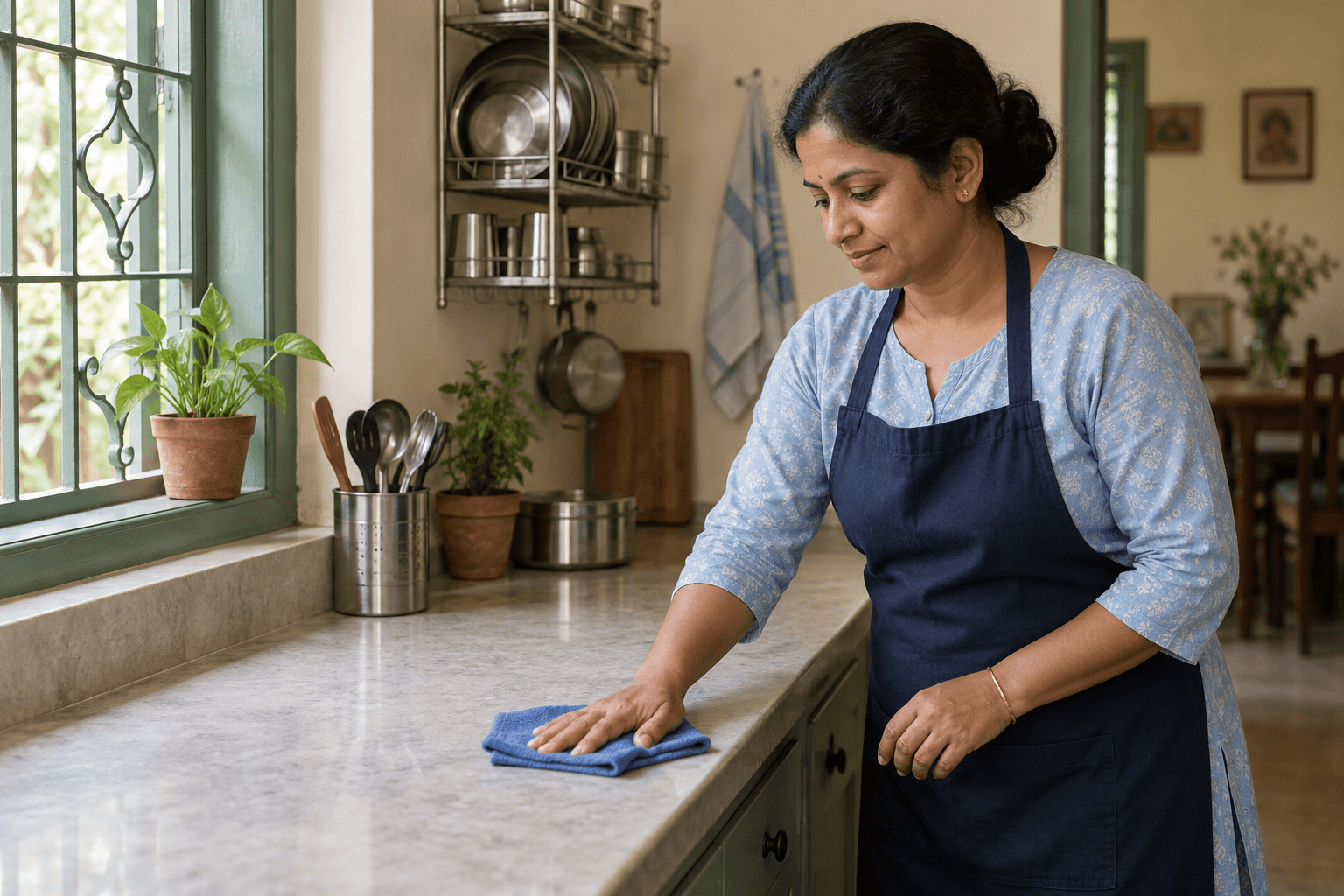
For a confirmed natural-granite countertop, remove crumbs, use a compatible mild cleaner or stone-care product as directed, rinse if required and dry with a soft cloth. First confirm the surface: kitchens may have granite, marble, engineered quartz, laminate or a stone-look coating, each with different care rules. If you cannot identify it, ask for the installer or product guidance before treatment.
Identify the counter and nearby materials
A polished, speckled appearance does not prove a worktop is natural granite. Ask for the purchase or installation record and note any named sealer. Check whether the worktop includes a different material around the sink, hob or edge. The Natural Stone Institute's care guidance begins with identifying the stone's composition because that determines compatible cleaners. It also warns that acids may harm sensitive minerals present even in some stones commonly called granite. Do not treat a generic “granite cleaner” label as proof of compatibility with every counter and sealer.
If a surface is marble or another acid-sensitive stone, refer to its own care instructions. If it is engineered quartz or a laminate that merely resembles granite, use its manufacturer's directions instead. Do not run a risky acid test on the counter to identify it. Material identification belongs in the cleaning brief, as does owner permission for any item moved from the worktop.
Set a short daily-care route
Clear small, owner-approved objects and food preparation items. Wipe loose crumbs with a soft, clean cloth rather than grinding them across the finish. Treat fresh spills promptly using the surface and cleaner instructions. For routine soil, use a product compatible with the confirmed stone and any sealer. Follow its dilution and application directions, rinse where directed and dry the surface; excess soap can leave a film. Avoid heavy scrubbing, scouring powder and improvised acid mixtures.
The Natural Stone Institute recommends neutral stone-care products or mild liquid dishwashing detergent and warm water for ordinary cleaning, with thorough rinsing and drying. That is general industry guidance; the installed product's own instructions still govern. Its countertop sanitation bulletin specifically cautions against vinegar until the particular stone and any sealer are checked. This page does not provide a sterilisation or food-safety guarantee. Keep cleaning tools used in the bathroom separate from those used on food-preparation surfaces.
Do not treat every mark as dirt
| Observation after ordinary care | A reasonable next step | What not to assume |
|---|---|---|
| Loose crumbs or new spill | Wipe promptly with the approved method | That prolonged scrubbing is needed. |
| Hazy film after cleaning | Review cleaner dose and rinse/dry instructions | That the stone needs aggressive polishing. |
| Dark mark that persists after drying | Record location and history; ask the installer or stone specialist | That a household cleaner can remove a stain safely. |
| Dull patch, flaking coating or chipped edge | Stop and document the condition | That stronger chemistry or a new sealer will fix it. |
A dark area near a sink might be temporary moisture, an absorbed stain, a damaged sealer or another condition. The table does not diagnose it. Avoid copying internet stain-removal recipes involving solvents, poultices or bleach; those treatments can damage a finish or require specialist handling. If the worktop has a chip, loose edge or damaged joint, a cleaning visit cannot repair it.
Keep the counter-cleaning scope separate from organisation
Cleaning the surface is one task; sorting stored items, rearranging appliances and discarding old food are different permissions. The kitchen-counter organisation guide helps decide where items belong. In a quote, specify which appliances can be moved safely, whether backsplashes and cabinet fronts are included, and who replaces objects after cleaning. The kitchen-cleaning scope sheet can hold those decisions without assuming every adjoining surface is granite.
A fictional Kolkata family has a stone-look island and a natural-granite run beside the hob. Their brief labels each area, asks for an ordinary compatible wipe on the granite, and excludes the island until its material is identified. One dark ring near the sink is recorded as an existing mark. That prevents a cleaning visit from turning into an unapproved attempt to remove a stain with a product intended for a different material.
Ask for the right quote
When enquiring, send the counter material if known, approximate worktop area, photographs of unusual marks only with permission, any sealer or manufacturer instruction, and the tasks expected around appliances. Ask what method and supplies would be used and what remains outside scope. If the worktop requires stain treatment, polishing or resealing, seek an appropriate stone-care provider rather than listing it as ordinary home cleaning.
For Kolkata home cleaning, contact Anjali Aaya and Nurse Care on +91 98041 26771 or WhatsApp to check actual availability, equipment and a complete quote. This guide describes a decision method, not a promise that every natural-stone task is offered.