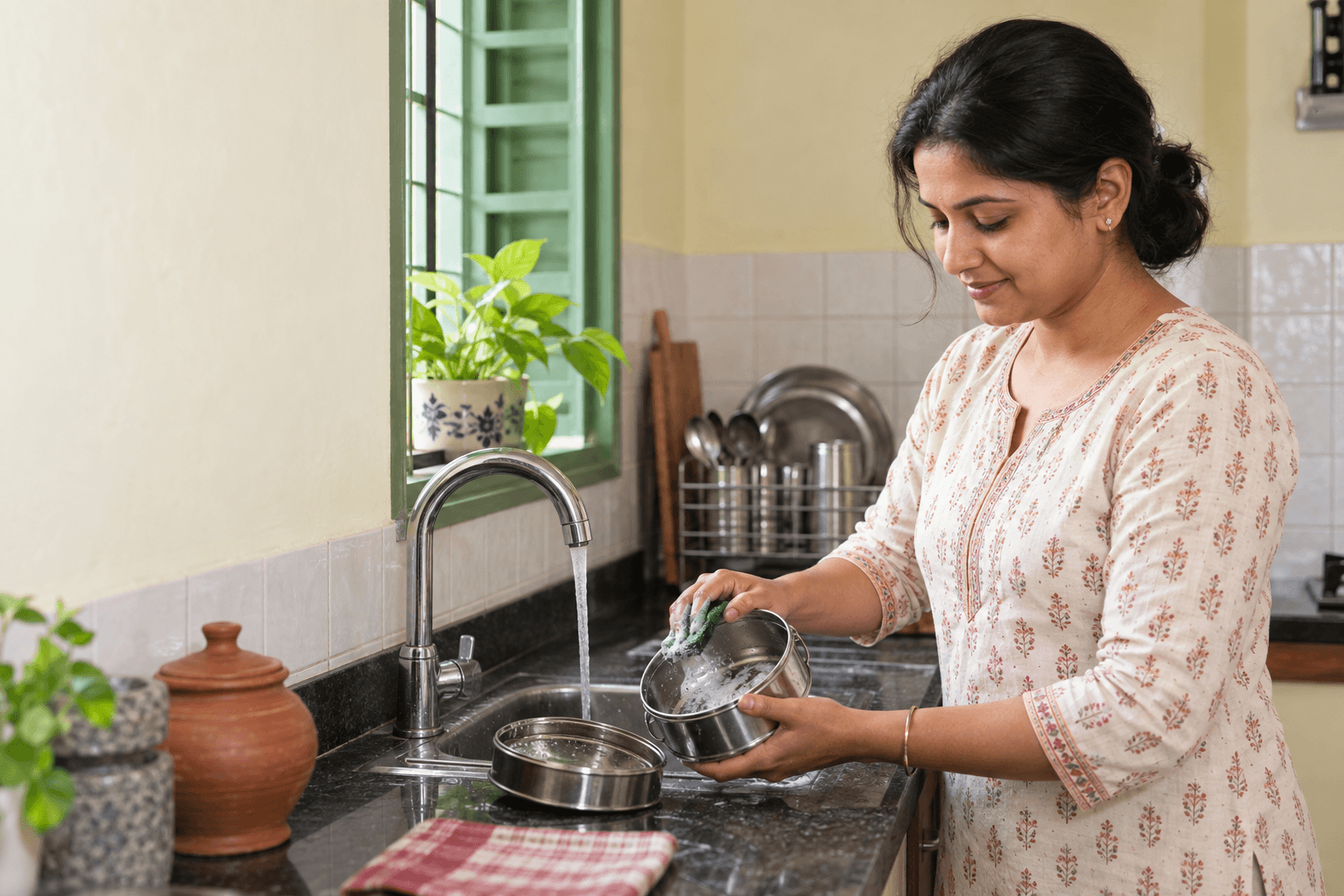
An ordinary bottle-cleaning task ends with the correct complete bottle ready for its next use. Begin with one identifiable set, follow its maker's care method and keep unfinished items out of the ready-to-pack area. Similar-looking lids may belong to different bottles.
This guide concerns ordinary reusable household drinking bottles. Baby-feeding equipment, medical devices, electrical lids and containers with uncertain previous contents need their own guidance. Do not force apart a closure that is not designed for user disassembly.
Identify what belongs to the bottle
Start with one complete item on a clear surface. Note who uses it and where it should return. If two family members have similar bottles, use their established identifiers instead of relying on where someone left them in the sink.
Keep the household's sets distinguishable throughout the job. A small clear area for each bottle is easier to follow than one mixed heap of lids. Do not quietly exchange lids between household members to complete a set.
Choose the method before filling the sink
Locate the exact model's care information. The dishwasher compatibility register can keep confirmed choices accessible for the next person sharing the work.
Hydro Flask's care article describes handwashing suitable products with warm soapy water and a bottle brush. It also distinguishes dishwasher eligibility and separates lids, caps and straws for that route. This is an example of product-specific care, not a rule that every reusable bottle can go through a dishwasher. Hydro Flask bottle care
Set up the required materials before beginning, keeping the household's surface-cleaning cloth out of this bottle-care setup. If the appropriate tool is missing, identify that gap before the morning packing deadline.
Work through the parts without losing the sequence
During the work, keep unfinished items on one side of the process and completed work in its designated place. A crowded drainer makes stages easy to confuse. If interrupted, leave a simple status message rather than relying on the next person to infer progress from appearances.
CamelBak's reusable children's-bottle guidance says to separate only intended removable parts and check each component's cleaning method. For permitted handwashing, use appropriately sized brushes to reach the body's base and opening and the straw's interior. Rinse away soap, including inside the straw and around lid connections. Let every part dry separately before reassembly, then check its fit and condition. Follow the actual product's instructions; this example does not establish compatibility for every bottle. CamelBak bottle-care guidance
Do not turn a persistent stain or unknown residue into a stronger homemade treatment. Seek the actual maker's next-step advice. A bottle that still presents an unresolved concern should remain separate from the ready-to-use set.
| Household bottleneck | Practical adjustment | Useful outcome |
|---|---|---|
| Two lookalike sets arrive together | Use established household identifiers | Correct owner receives each set |
| Drainer already full | Return ready dishes before adding another job | Work stages remain visible |
| Visit ends before completion | Name what is still outstanding | Next person receives an accurate handover |
| One bottle is needed immediately | Ask which already-ready alternative is available | Incomplete work is not called finished |
| New product has no available guidance | Owner locates the model information | Future routine has a usable reference |
Reassemble only the intended set
Make the handover simple: ready, still drying, or awaiting an owner decision. If several bottles are being prepared for the next morning, put only ready items in the agreed collection area. Keep anything still being worked on visibly separate.
The utensil return-location map can identify where each person's bottle belongs. This is especially useful when an ordinary cleaning task is shared between a cook, a household helper and family members.
Fictional example: three bottles for the next day
A Joka family leaves three reusable bottles after the evening meal. Two have familiar instructions and matching lids. The third has an unfamiliar drinking mechanism and no available care information. The family identifies its product before adding it to the accepted washing work.
The helper handles the two confirmed bottles separately, keeps their components paired and uses their permitted cleaning routes. One closure is still drying when the family asks for everything to be packed. It remains in the drying area with its bottle identified; the family uses another ready item rather than calling the incomplete set finished.
For the broader sink workflow, use washing dishes by hand. If requesting dishwashing help in Kolkata, mention reusable bottles and their care information explicitly. Call or WhatsApp Anjali to confirm accepted duties, timing, availability and the full quote.