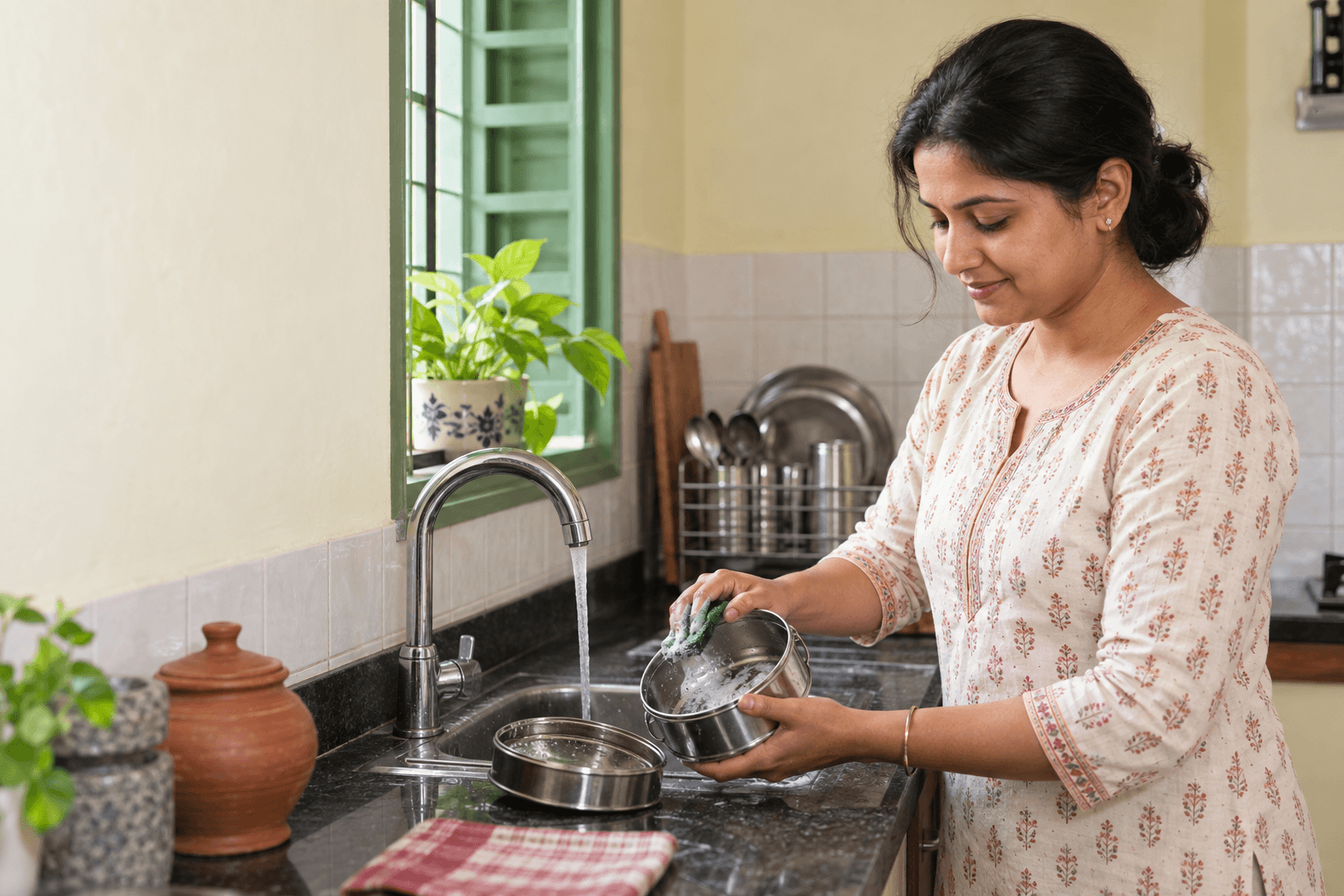
A manageable handwashing routine needs room for each stage, a clear distinction between finished and unfinished items, and enough attention for the cookware that needs different handling. Start with a workable kitchen layout instead of treating the entire pile as one identical task.
This guide helps organise that sequence in a household kitchen. It does not provide a sterilisation process, guarantee that every stain will disappear or establish that all items can be soaked. Actual utensil and product instructions remain the starting point.
Make room for the whole process
Before adding water, identify where dirty items will wait and where washed items will be rinsed and dried. A clear washing space is only one part of the task. If the drying rack is full of yesterday's items, solve that bottleneck before starting a large new pile.
Move already-clean items to their proper places when they are ready to be put away. Keep them separate from the incoming batch. If a cupboard destination is unclear, use the utensil return-location map rather than placing clean dishes back among unwashed ones.
Work in manageable groups. The useful group size depends on the actual sink, drying arrangement and items, so this article does not set a universal number of plates per batch. Leave enough space to handle each item deliberately.
Follow the basic handwashing sequence
The American Cleaning Institute provides this basic sequence for compatible household items; actual product and utensil instructions still apply. ACI: Washing Dishes by Hand
| Stage | Practical action |
|---|---|
| Prepare | Scrape loose food into the appropriate waste arrangement |
| Set up | Use clean water and a hand-dishwashing product as directed on its label |
| Wash | Work through suitable items, generally beginning with lighter soil before greasier cookware |
| Rinse | Remove suds and residue with clean water, including the inside of cups and bowls |
| Dry | Use a suitable air-drying arrangement or a clean drying towel |
| Finish | Attend to the sink, drainer and washing tools rather than leaving the work area dirty |
Use the product's actual dose and directions; extra foam is not evidence of extra cleaning. Replace unsuitable wash water rather than continuing with a greasy batch. Soaking must be permitted for the actual item, and knives must not be hidden in a pile in the sink. ACI handwashing guidance
Treat cookware as its own part of the job
A hot pan arriving straight from cooking should not be treated like an ordinary used plate. Tefal's cookware guidance says to let pans cool before soaking and warns that putting a hot pan into cold water can cause warping. It also describes a soft sponge for handwashing its cookware. Apply the directions for the actual pan, rather than assuming every coating accepts the same scrubber or treatment. Tefal cookware care
Keep an uncertain or damaged item apart from the accepted ordinary batch until its handling is clarified. Do not use an abrasive tool merely because a mark remains after the usual method. Stain removal, burnt-on residue and routine washing can require different decisions.
For a household that also uses a dishwasher, the dishwasher compatibility register answers a separate question: which items have instructions permitting that appliance use. Being unsuitable for one method does not automatically prove that any alternative method is suitable.
Keep the clean side from becoming another dirty pile
As washing progresses, check whether the rinse and drying areas can receive the next group. If not, pause the incoming work rather than stacking items into an unstable or confused arrangement. A clear route from dirty to washed to drying makes it easier to see what remains.
The Food Standards Agency advises keeping utensils and dishes clean between tasks and using separate cloths for surfaces and washing up. It also recommends washing or changing cloths regularly and drying washed cloths before reuse. Those household principles support a clear distinction between cleaning a work surface and handling the washing-up tools. FSA household cleaning guidance
Do not let “washed” become a label for every item near the sink. A pan waiting for further care, a bowl that has been rinsed and a plate ready to return are at different stages. Their placement should make the stage understandable to the next person.
Fictional walkthrough: breakfast finishes while lunch begins
A fictional Kolkata household has used cups, plates and one cooking pan after breakfast. The cook will need the work area again for lunch. The family initially asks the helper to clear the entire pile immediately.
The helper first finds that the drying rack contains clean items from an earlier meal. Once the household has returned the ready items to their agreed places, there is space for the new batch. The cups and plates can pass through the ordinary confirmed handwashing process.
The pan needs its own care directions and appropriate cooling before handling. It is kept identifiable rather than hidden under other dishes. The cook and helper agree when it is ready to enter the accepted work.
After the ordinary batch is completed, the remaining pan is visible as a specific outstanding item. The household has a clear picture of progress without pretending that clearing the sink and completing every item are always the same thing.
Resolve the practical bottleneck
If the process repeatedly stops, identify where. A full drying rack needs a return arrangement. Dishes arriving throughout the visit need an agreed handover point. An unsuitable tool needs correction. Adding speed to the request does not resolve those different obstacles.
Use the dishwashing scope and completion worksheet when you need to record which batch is included and what was completed. Keep that counting task separate from the washing method described here.
For dishwashing help in Kolkata, discuss the ordinary items, water and equipment available, the cook's timing and whether return to storage is included. Contact Anjali Aaya and Nurse Care by phone or WhatsApp to confirm suitable scope, availability and the quotation.