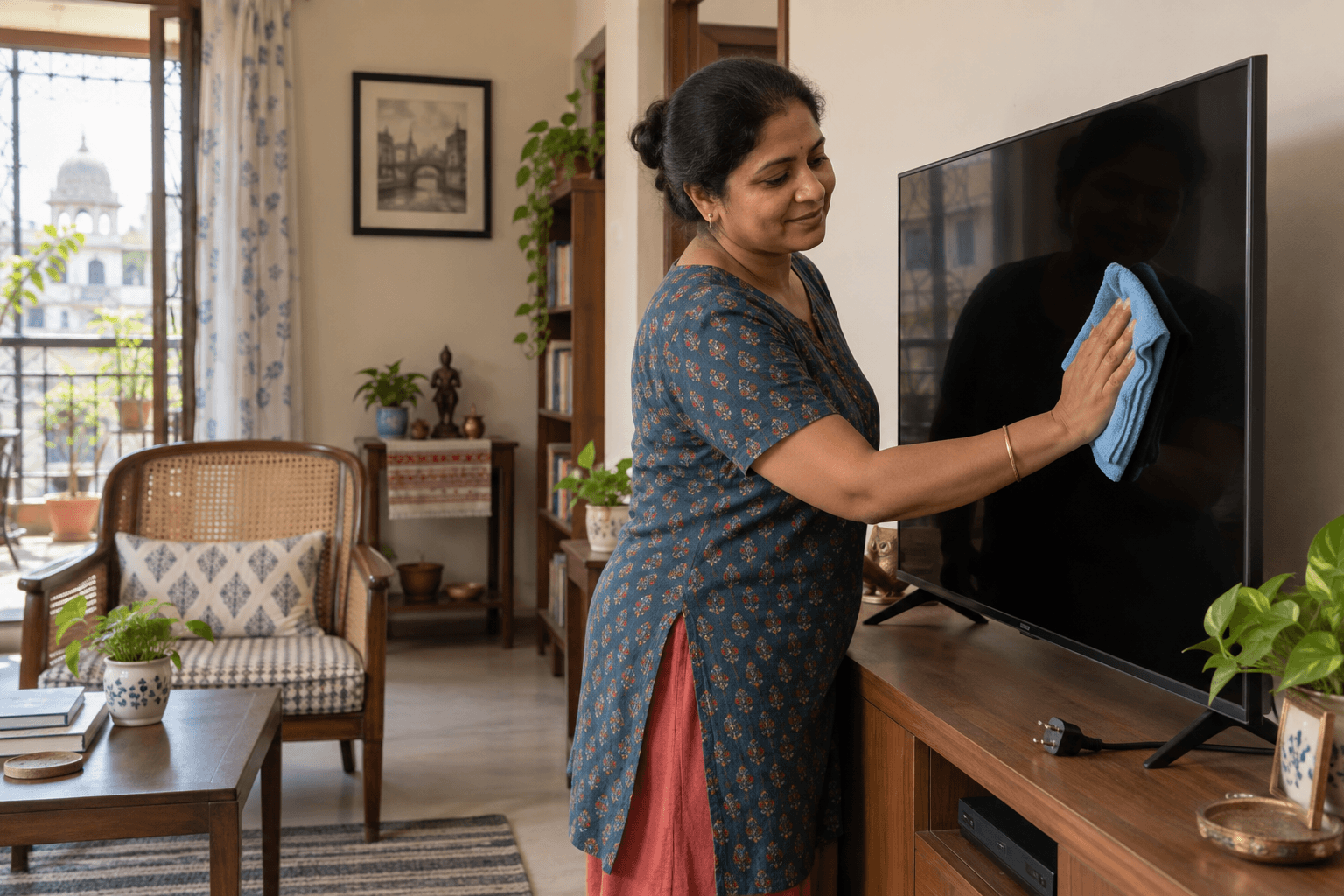
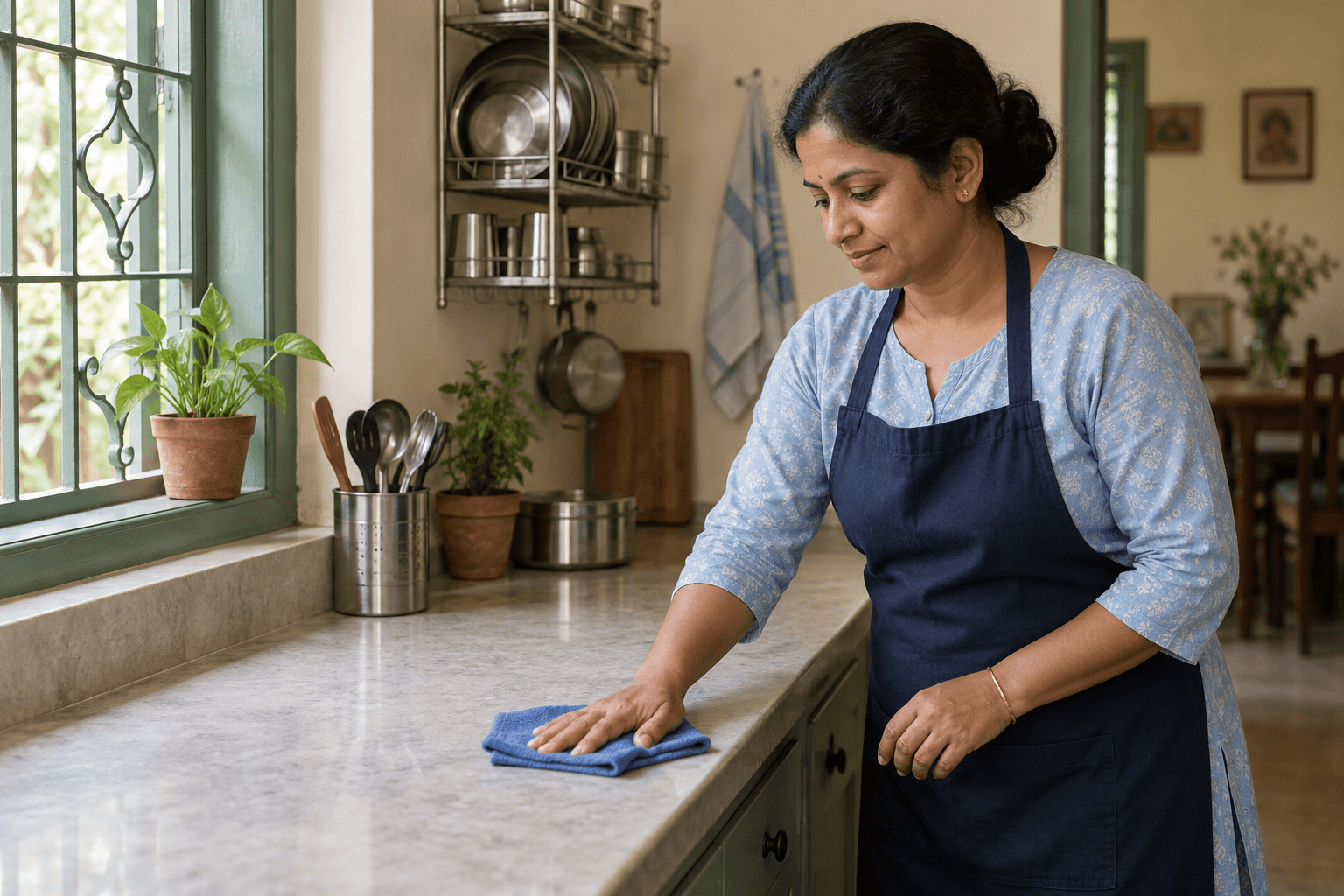
For ordinary furniture dusting, work on one accessible surface at a time, use the method allowed by its care instructions and check the edges as well as the obvious middle. Remove loose dust without turning the task into polishing, stain removal or restoration. Return movable belongings after the surface is ready, then check what was missed.
A methodical pass is more useful than moving quickly around every visible object. In a Kolkata home, a work desk, a bedside table and a display shelf may all be on the same chore list, but they do not necessarily need the same treatment. This guide focuses on everyday accessible furniture with known, stable surfaces.
Distinguish dust from a mark that needs another decision
Look at the surface before wiping. Loose dust, a dried spill, a scratch and a worn patch are different observations. Start with the loose dust that the furniture's instructions permit you to remove. Do not keep rubbing a remaining mark simply because it is still visible.
IKEA's furniture guidance recommends gentle movements with an appropriate cloth and notes that material and finish affect the cleaning method. It also cautions against abrasive products. Use those principles with the actual item's care directions; they are not permission to use one product on every piece. IKEA furniture care
If the finish is flaking, sticky, loose or unidentified, routine dusting may not be the right next step. Leave that piece for suitable care advice. Antiques and objects with fragile decoration need a different approach from an ordinary desk; this article does not provide conservation instructions.
Choose a starting area you can finish
Begin with a small surface whose belongings can be moved and returned without difficulty. Clear it in a controlled group instead of relocating everything from the room. The point is to expose the working surface while keeping the original arrangement easy to restore.
On a desk, that might mean moving the agreed stationery tray and a closed notebook to a nearby clear place. Leave plugged-in equipment, tangled cables, fragile displays and private papers to their own arrangements. Cleaning around an excluded object is different from having permission or the ability to move it.
Check access before starting. Restrict this routine to surfaces that can be reached comfortably from the floor. Standing on furniture or stretching across unstable objects adds a separate problem to an otherwise ordinary task. A high cabinet top should not silently become part of an accessible shelf routine.
Make one deliberate pass
Use the cloth or tool specified for the surface, in a suitable clean condition. If the instructions require a dry method, do not dampen it just because a different piece was wiped that way. If wiping with moisture is allowed, follow that item's instructions rather than interpreting “damp” as permission to soak it.
Work through the exposed area in a consistent order. For example, cover the left section, then the middle, then the right, checking the front edge before returning objects. The exact direction is less important than knowing which portion has already been covered.
Do not flick collected dust towards belongings or a finished surface. As the cloth becomes visibly loaded, change to a clean suitable section or another prepared cloth. Finish the area under the agreed movable objects, then deal with those objects only if their own care is part of the task.
IKEA advises applying a suitable cleaning product to the cloth rather than directly spraying the furniture and drying wood after permitted wet cleaning. These are examples within its material-care guidance, not a universal recipe or an instruction to introduce cleaner during every dusting task. IKEA care guidance
Check the parts that an initial pass can miss
| Checkpoint | What to look for | What to do next |
|---|---|---|
| Exposed middle | An area skipped while working around an object | Complete that part using the accepted method |
| Front and side edges | A visible line of dust separate from the top | Include accessible edges if their care is understood |
| Space beneath a movable item | A clear outline where the object stood | Finish the exposed section before returning it |
| Decorative or awkward section | Dust that the ordinary method cannot reach appropriately | Leave it for a suitable separate approach |
| Remaining mark | A scratch, stain or finish change rather than loose dust | Report it without escalating pressure or products |
| Returned group | An item now in the wrong place or blocking use | Restore the agreed arrangement |
This is an inspection sequence rather than a demand for a particular shine. A naturally matt or worn surface does not have to become glossy to count as dusted.
Fictional walkthrough: a reading corner
In a fictional Joka household, the agreed task is a small side table and one reachable bookshelf section. The side table has a lamp, two coasters and a small book stack. The household moves the lamp itself and leaves its wiring alone.
The helper places the coasters and books in a clear temporary group, follows the table's known care instructions and works across the exposed top. A mark near one edge remains after the ordinary pass. Instead of trying a stronger product, the helper identifies it separately.
On the shelf, the household has agreed which book group may be moved. The helper finishes that exposed section, checks the front edge and replaces the books in the original order. A decorative object with delicate parts remains outside the task.
At the end, the household can see what was completed and what requires a separate decision. The routine has not created a room-wide reorganisation or a promise to remove every mark.
Treat upholstery as a separate surface
A fabric sofa needs its own care instructions. Use the fabric-sofa routine-care guide to distinguish the cover, cushions and filling before choosing a permitted method.
Fit dusting into the household routine
Use the room-wise chore planner to allocate areas across visits, especially where a full room contains many belongings. A rotation should describe real tasks such as the accessible table and shelf section, rather than add a vague instruction to “dust everything.”
Keep suitable cloths and tools identifiable in the cleaning supply inventory. If misplaced belongings repeatedly prevent access, consider a separate organisation task; dusting does not require redesigning the room.
For home cleaning in Kolkata, explain which accessible furniture surfaces are included and any known care restrictions. Confirm the scope, hours and quote with Anjali Aaya and Nurse Care by phone or WhatsApp.