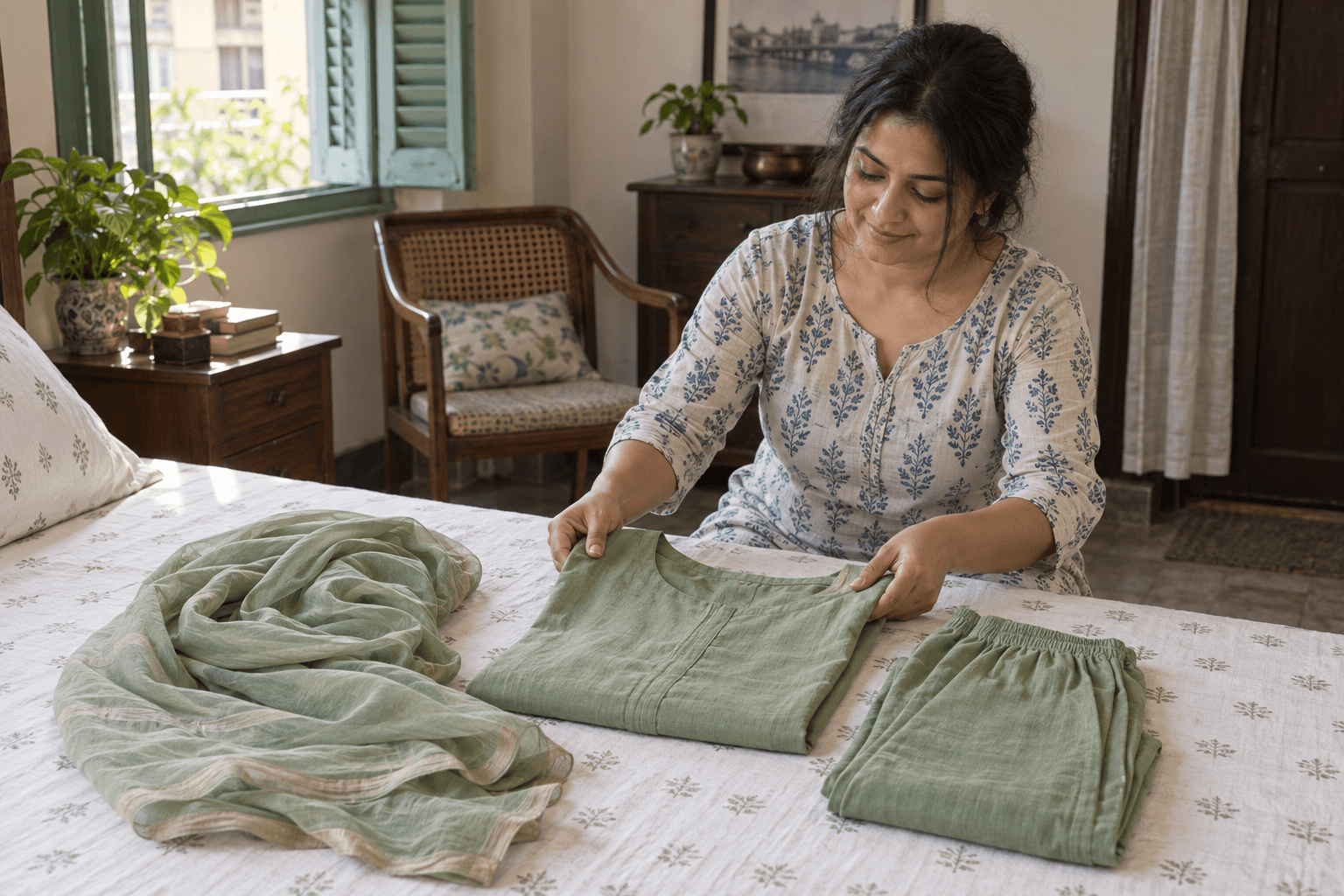
To store a salwar kameez set, decide whether the kameez should hang or fold, fold the salwar or churidar without trapping its waistband, and loosely fold or drape the dupatta according to its fabric. Keep all pieces identifiable as one set. Plain cotton, sequins and delicate silk need different handling; the garment's own care instructions govern.
First make sure the set is ready
Count the pieces: kameez or kurta, salwar/churidar or other bottom, and dupatta if the outfit has one. Check that every piece is clean and completely dry before storage. A damp hem or scarf should go to an appropriate drying area rather than the wardrobe. If a garment has a pending stain, loose embroidery, torn seam or dry-clean-only care requirement, mark that condition before folding. Do not quietly treat a three-piece outfit as complete when the matching dupatta is still in the laundry.
Choose a clean, dry surface big enough to lay out the longest piece. Clear any jewellery, pins or clips that could catch on fabric. Look at the fabric and embellishment, the shelf depth and the owner's usual way of finding outfits. IKEA India's clothes-storage guide shows that long garments and folded stacks need different space. Its wardrobe guidance treats hanging and folding as choices based on the clothes, not a rule that every item must fit one drawer. A garment maker's instructions remain more specific than a wardrobe retailer's general advice.
Choose hang or fold for the kameez
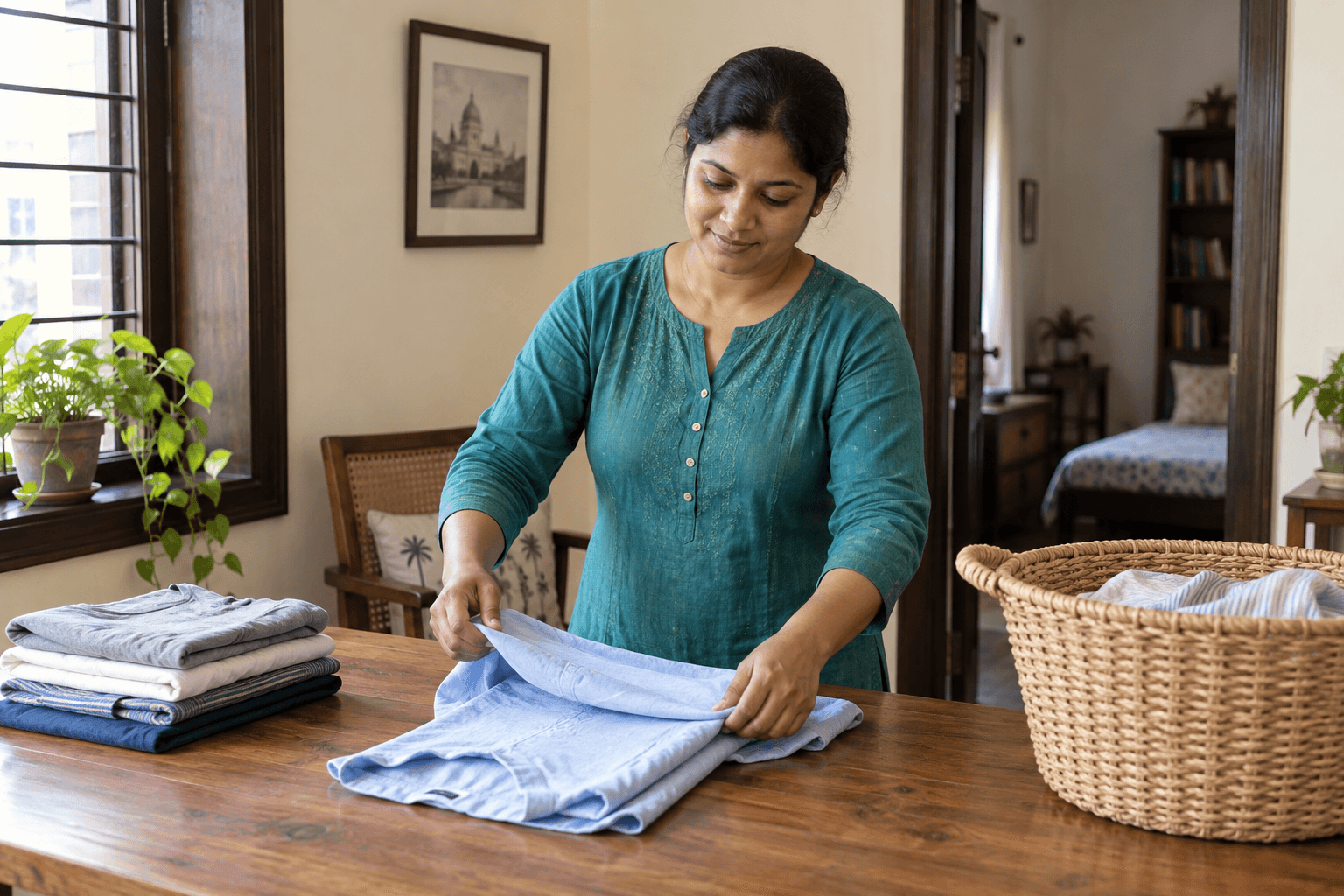
For a plain everyday cotton kameez that the owner already stores folded, lay it face down with sleeves spread gently. Smooth it with open hands instead of pressing hard on seams. Bring each side and sleeve toward the centre to form a rectangle no wider than the planned shelf. Fold the lower part upward in broad sections, keeping the neckline and decoration from being crushed under a heavy stack. Use fewer folds if the fabric is thick or the garment is long. Try one finished item on the shelf before repeating the method for a full load.
For a structured, heavily embroidered or easily creased upper garment, hanging may be more suitable if the label and owner allow it and there is proper support. Manyavar's Indian-wear care note advises checking the label and hanging some kurtas to preserve shape. That does not mean all salwar kameez pieces must hang; heavy decoration can also make an ordinary hanger unsuitable. Ask how the family normally stores this particular item, and refer especially delicate or valuable pieces to garment-care guidance rather than improvising a sharp fold.
Fold the bottom so it remains recognizable
Lay the salwar or churidar flat, align the legs without stretching elastic or drawstrings, and fold along its natural construction. A roomy salwar may need a broad vertical fold before being folded to shelf length. A narrow churidar can be brought together at the legs and folded more simply. Keep the waistband accessible so the matching set can be checked at a glance. Avoid tucking small accessories into a fold where they could snag or disappear.
If the bottom has pressed pleats or a designed crease, preserve the direction the owner prefers. The general clothes-folding guide gives a rectangle-and-fit test for ordinary trousers. This guide adds the outfit-specific question: does the bottom still match the upper garment after items move between washing, ironing and storage? If a set number or label is used, place it on a reusable storage note or compartment, not an adhesive directly on fabric without consent.
Handle the dupatta as its own textile
A plain, resilient dupatta may be folded lengthwise into a broad strip, then in loose sections that fit the compartment. Align decorative borders so they are visible without repeatedly opening the whole bundle. A sheer, embroidered or delicate dupatta may need a different approach: loose draping, a suitable hanger or garment-specific professional guidance. Do not force beads, zari or raised embroidery into a tight crease. Avoid using safety pins through fabric solely to hold the set together.
The key is to make the outfit findable without crushing a delicate piece. In one household, a folded dupatta may sit on top of the salwar beside the hung kameez. In another, all three pieces may share an agreed labelled shelf. There is no need to buy an organiser if the existing shelf works; a stable return location matters more than a new container.
| Piece | Everyday choice | Check before return |
|---|---|---|
| Kameez or kurta | Broad fold for suitable plain fabric, or supported hanging | Neckline, sleeves and embellishment are not distorted. |
| Salwar or churidar | Align legs and fold to shelf depth | Waistband and drawstring remain accessible. |
| Dupatta | Loose broad fold or approved hanging | Border and decoration are not crushed or snagged. |
| Whole set | Same shelf/section or clear cross-reference | Three pieces can be found without moving unrelated clothes. |
Test the storage once
A fictional Kolkata family has two similar blue cotton suits. The first attempt puts the kurtas on separate hangers and all dupattas in one drawer; a hurried family member pairs the wrong scarf with a suit. Their revised plan keeps each dupatta and bottom together in its designated section and places a small written location note on the hanger rail for each kameez. The note is on furniture, not on the garment. After one week, they can see whether the system helps or whether a simpler shelf stack would be better.
For household help, specify whether the task is to fold only, to match clean pieces to outfits, or to change the wardrobe layout. Those are different permissions. The wardrobe organisation guide covers the larger arrangement, while the garment care register can record unusual instructions. For laundry-help enquiries in Kolkata, call +91 98041 26771 or use WhatsApp; confirm whether matching, folding and wardrobe return are included in the actual quote.