
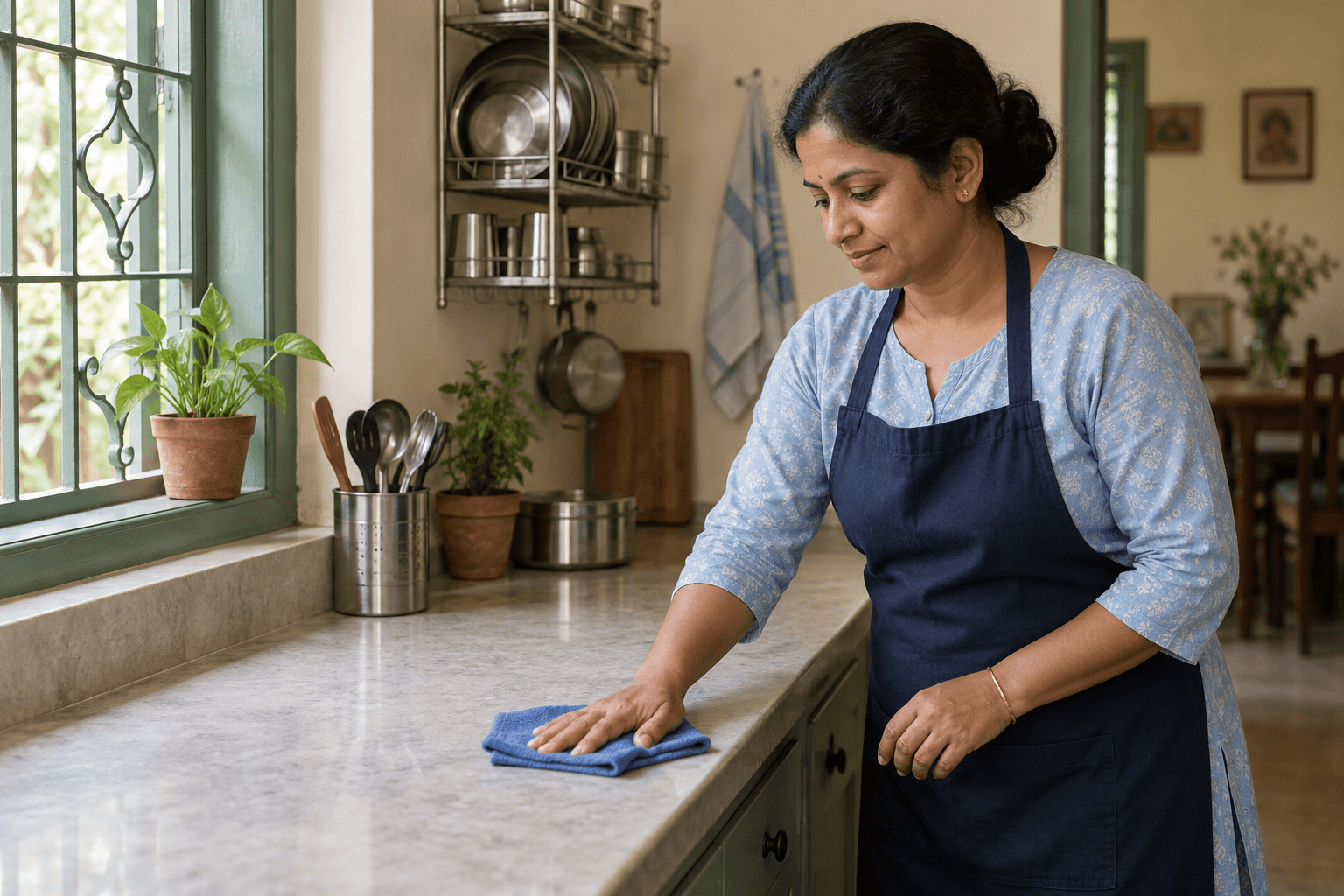
To clean an ordinary accessible mirror, identify its care instructions, prepare a suitable clean cloth and use only the permitted method on the intended surface. Work through manageable sections, inspect the result from more than one angle and return the surrounding area to use. A mirror's frame, edges and any electrical features need their own care instructions.
This guide covers a securely mounted ordinary household mirror that can be reached from the floor. It does not cover climbing, removing glass, repairing a damaged backing or working on illuminated, heated or powered units without the relevant product directions. A reflective surface is not permission to use every product sold as a glass cleaner.
Identify the mirror and the task
Look for the maker or product instructions available to the household. Note whether the mirror has a frame, an applied coating or special features. Tell the owner about visible chips, looseness or existing marks before work begins. If its mounting seems uncertain, leave cleaning aside until the household has the issue addressed.
Separate the glass face from neighbouring materials. A timber frame, painted wall, stone counter and metal fitting may surround one mirror. A method accepted for the glass does not automatically apply to all four. The cleaning supply inventory can identify the products already available, but the presence of a bottle in the cupboard does not prove compatibility.
Agree the reachable area. If the top cannot be accessed from the floor, say so clearly. Do not stand on a basin, chair or other improvised support to make the whole mirror appear included in an ordinary surface-wiping task.
Prepare the cloth and surrounding space
Use a suitable clean, non-abrasive cloth consistent with the maker's instructions. Check that it does not contain grit or residue from a previous task. A cloth just used on a different surface may transfer its product or dirt, so start with a clearly identified cloth for this job.
Move only the nearby items that the household has permitted you to move. Put them on an agreed dry surface, keeping personal items together. There is no need to open a bathroom cabinet or reorganise its contents to wipe the outside mirror. The organisation consent-zone map helps when the surrounding storage has private areas.
Keep the product in its labelled container and follow its directions alongside the mirror maker's instructions. Do not mix products or add a household ingredient to strengthen the cleaner. If those sources do not establish a compatible method, ask for clarification instead of creating a recipe.
Use the manufacturer's method without spreading it to every mirror
Kohler's mirror-cabinet guidance describes applying its specified product to a soft cloth before wiping the mirrored surface. That is a product-specific example, not a recommendation to use the same cleaner on every mirror.
The Robern framed-mirror instructions specify a lint-free polishing cloth, prohibit abrasive cleansers and distinguish care of the metal frame. This difference illustrates why identifying the actual product matters. Use the instructions for the mirror in front of you rather than combining selected parts of several manufacturers' methods.
When the approved method is clear, begin with an accessible section and use controlled, overlapping passes so you can see what has been covered. Keep the cloth in contact without scrubbing forcefully. Work systematically across the face, changing to a clean usable part of the cloth as required by the task. Follow the maker's guidance for edges, liquid application and drying; do not let an improvised spraying routine decide where cleaner lands.
Inspect before repeating the whole job
Step back and view the accessible area in ordinary good light. Change your viewing angle to identify missed patches, cloth lint or remaining smears. These observations are different from scratches or marks behind the reflective surface. Do not assume every visible line can be removed by stronger wiping.
For an ordinary missed patch, return only to that section using the permitted method. If the cloth is leaving residue, stop and reassess the cloth and product rather than spreading the same residue over the rest of the mirror. A second full pass is not automatically the answer to every imperfect-looking result.
If a mark persists, tell the owner what remains and what routine was used. Do not escalate to a blade, abrasive pad or unapproved chemical to meet an undefined demand for a new-looking finish. Cleaning and repair are separate decisions.
Fictional example: fingerprints, lint and an old edge mark
In a fictional household, an accessible mirror has several fingerprints and a dark mark near one edge. The owner confirms that the edge mark was already present. The maker's instructions and a compatible product are available, and the agreed task covers the reachable mirror face only.
| Observation | Action in this fictional task | What is checked afterwards |
|---|---|---|
| Fingerprints on the central area | Use the confirmed routine with a suitable cloth | Central area inspected from another angle |
| First cloth leaves visible lint | Stop and select a suitable clean cloth | Lint is no longer being introduced |
| Small section was missed | Revisit that section only | Coverage checked against the surrounding face |
| Old edge mark remains | Do not scrub or attempt backing repair | Owner receives a factual remaining-mark note |
| Bottles were moved with permission | Return them to their agreed positions | No private storage is opened |
| Upper strip is outside safe reach | Leave it outside the completed area | Handover states the actual boundary |
The result is an accurately described ordinary clean, not a guarantee that every mark disappears. This example does not diagnose the dark edge or prescribe its repair.
Finish the surrounding area as well
Check the nearby agreed surfaces for any accidental drips or displaced items, responding according to their own care instructions. Put supplies away in the household's usual place. Keep the cloth's next destination clear so a used mirror cloth is not mistaken for a fresh cloth ready for another task.
Report the scope in plain language: reachable mirror face completed; existing edge mark unchanged; upper strip not attempted. That is more useful than saying the bathroom is done when only one surface was included. The bathroom cleaning scope can connect this task to the other agreed fixtures without treating them as a single interchangeable surface.
For household cleaning enquiries in Kolkata, share the mirror location, reachable area and any relevant instructions by WhatsApp or call. Confirm availability, duties and the complete quotation. Mirror cleaning does not establish specialist glass repair, elevated-access work or powered-unit servicing as available services.