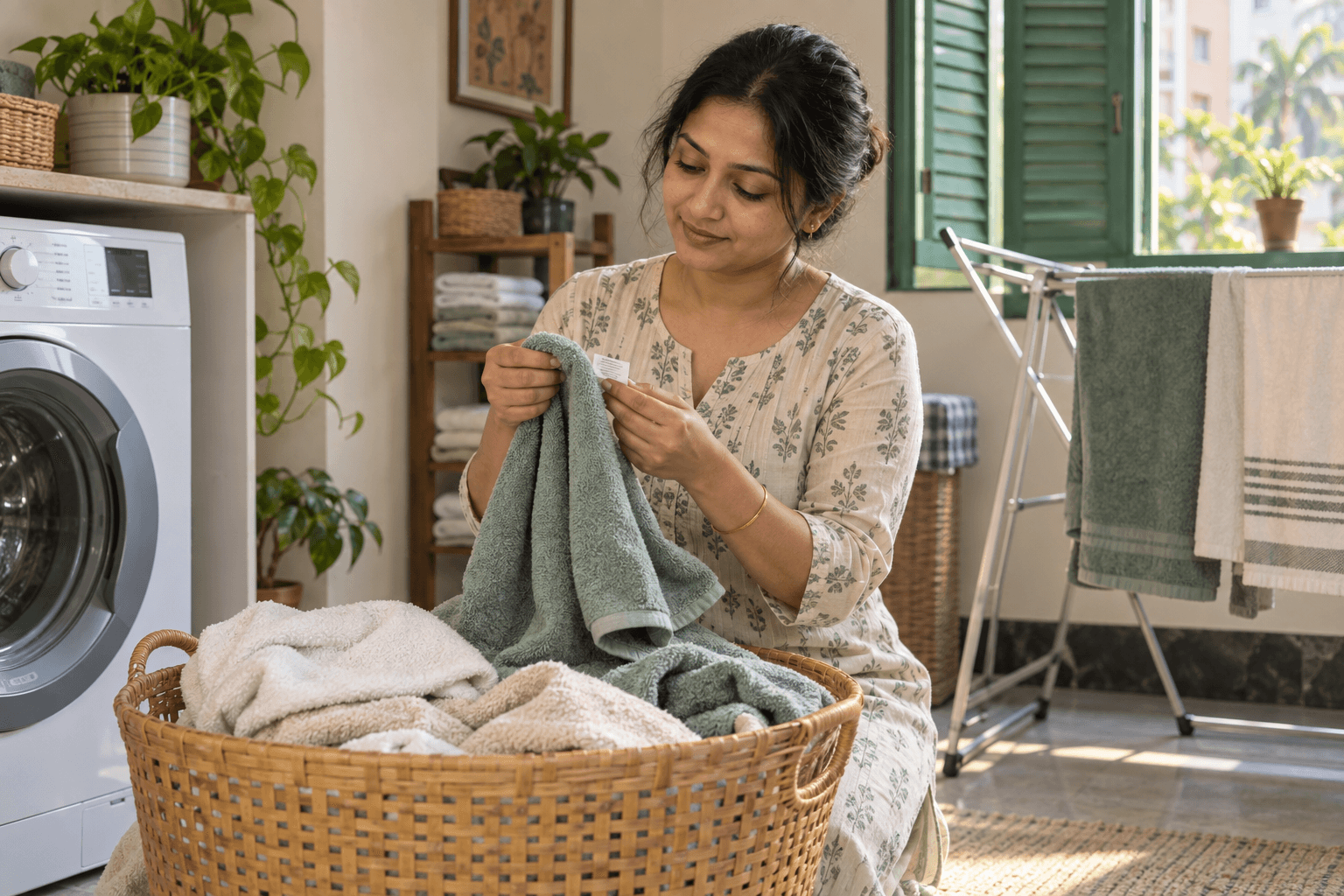

Sort laundry by the care method each item permits, then separate incompatible colours, fabric weights and soil levels. A usable load is a group that can share the same permitted process, not merely a basket of similarly coloured clothes. Keep unresolved items outside the ready loads and identify a drying destination before starting a machine.
This guide turns a mixed basket into actual wash groups. It does not select a universal cycle or temperature. The garment labels, detergent directions and instructions for the household's machine remain the sources for those decisions.
Start with an empty sorting area
Create a place for ready groups and one separate place for items awaiting a decision. Label groups with a short description or put a note beside each container. Avoid naming every group cotton or dark if those words conceal different washing instructions.
Bring all the items intended for this session to the sorting area. A stray towel discovered after a wash starts belongs to a later decision; opening a ready group repeatedly makes it difficult to remember what has already been checked. Where several people share laundry, confirm which clothes are included before emptying private bags or unrelated cupboards.
Check pockets according to the household's agreed arrangement. Found objects need their own return location. The pocket-check station handles that step; it cannot determine the washing compatibility of the now-empty garment.
Build the groups in a deliberate order
Whirlpool's sorting guidance identifies care labels, colour, fabric type and soil as sorting factors. Apply those factors in this practical order:
- Read the care instructions. Separate hand-wash, professional-care and unresolved items from the machine-wash candidates.
- Among machine candidates, identify items that share permitted washing conditions. Keep incompatible requirements apart.
- Separate colours where colour transfer is a concern, including unfamiliar new items.
- Consider weight and construction: heavy or abrasive pieces should not automatically join delicate garments.
- Keep heavily soiled pieces apart when their cleaning needs differ from the proposed group.
- Check the finished group against the machine's loading instructions before it becomes a ready load.
A smaller-looking pile is not automatically a suitable load. Conversely, one broad colour category need not become one machine cycle. Sorting is finished when each ready group has a supported method and the unresolved pieces remain clearly separate.
Fictional basket: why three white items do not make one load
The table below describes invented garments with already checked instructions. Its purpose is to demonstrate grouping logic. These instructions are not recommendations for real clothes with the same fabric names or colours.
| Item in this fictional basket | Confirmed instruction or condition | Sorting decision |
|---|---|---|
| Two pale everyday shirts | Both permit the same machine process; similar weight | Group A candidates |
| White delicate blouse | Hand wash only | Separate hand-wash task |
| White household towel | Different permitted process from the shirts; heavy construction | Group B candidate |
| Dark everyday trousers | Compatible method with another familiar dark item | Group C candidates |
| New dark garment | Colour-transfer question unresolved | Hold for its specific instructions |
| Pale top with an unexplained mark | Treatment decision not established | Hold for owner or maker clarification |
| Spare pillowcase | Shares Group A conditions but changes the load size | Admit only after the final loading check |
The householder now has three candidate groups, a hand-wash task and two unresolved items. That does not mean three machine cycles must run immediately. The available time and drying arrangements decide which groups can actually be completed today.
If Group A fits the machine instructions and has a drying destination, it can become ready. If the pillowcase makes that group unsuitable, it moves to a later compatible group. It does not receive an exception simply because it is the final item in the basket.
Distinguish compatibility from convenience
When two items require different conditions, choosing the lower setting is not automatically a solution. One item may need a different action, construction protection or professional process. Find a genuinely shared permitted method; if that cannot be established, keep them apart.
A mesh bag also does not change a prohibited wash into an approved one. Treat accessories as part of the checked instructions for the relevant item. Likewise, a machine programme name that sounds gentle cannot override a garment's care restriction.
Do not combine half-full groups solely to reduce the number of cycles. Check what makes the groups different first. If the only difference is a household preference, the owner can reconsider that preference. If the difference is a care restriction, keep the restriction intact.
Make a short load card that survives an interruption
A useful note describes the group sufficiently for another person to continue without starting the entire sorting process again:
| Field | Example of useful information |
|---|---|
| Group identity | A: accepted pale everyday items |
| Items included | The checked list or clearly separated container |
| Shared process | Reference to the actual garment instructions |
| Machine check | Accepted load under this appliance's directions |
| Product instruction | The product to use and where its directions are found |
| Drying destination | Available location and permitted arrangement |
| Current state | Sorted, washing, awaiting transfer or complete |
| Excluded items | What remains outside and why |
Do not write invented settings into the card to make every field look finished. An unresolved instruction is a real state of the task. The garment care register is useful when those questions recur across visits.
When a group is ready, the washing-machine walkthrough takes that one load from selected programme to unloading and drying handover. Sorting decides compatibility; starting and completing the wash are separate steps.
Decide which load to do first
Choose from the groups that are genuinely ready. A promised outfit may be urgent, but urgency does not resolve an unreadable label. A group needing unavailable drying space is also not ready simply because the machine is empty.
Use the cycle sequence planner to decide how actual machine cycles fit a visit. Keep sorting and scheduling separate: the first establishes compatible groups; the second establishes a realistic order and handover.
At the end, check that no accepted item has disappeared between containers. Return excluded items with a specific question, such as confirm the new garment's washing instructions. For laundry help in Kolkata, describe the garments and stages you need covered through WhatsApp or call, then confirm availability and the complete service quote.